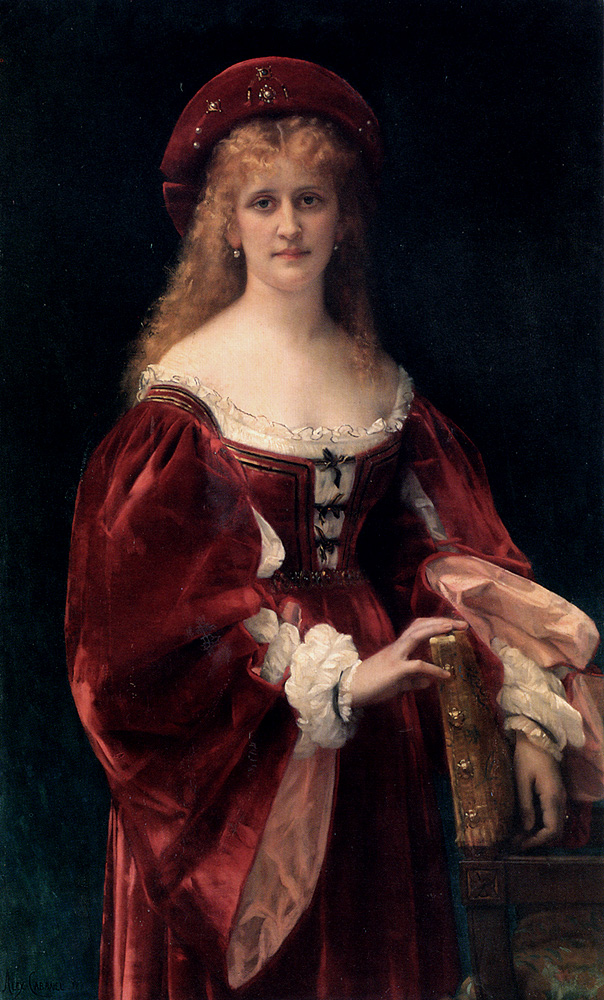
ALEXANDRE CABANEL, 1881
Famous in the 19th century as a painter of portraits and historical subjects, the French artist Alexandre Cabanel is remembered today for his 1847 vision of Lucifer in The Fallen Angel. He worked largely in the academic style, which followed the teachings of major European art academies, combining influences of Neoclassicism and Romanticism in his work.
Venetian Patrician is one of his lesser known portraits. The term patrician, from the Italian patrizio, refers to a member of the ruling class in the Republic of Venice, which was made up of rich families who held sway in government at the time. Members of these families used portraits to show off their lineage, wealth, and status, curating an image of power and grandeur to reinforce their social standing.
Cabanel drew inspiration from artists like Titian and Tintoretto, who painted many portraits of patricians throughout their careers, with the staging and expression of Venetian Patrician calling to mind Titian’s La Schiavona in particular. The sumptuous Renaissance dress and jewels worn by the model reflect the prosperity of the Republic of Venice at its height, and the luxuries enjoyed by its ruling classes.
While the model for this portrait may have come from a family with ties to the patriciate, this is likely not a true patrician portrait since the Republic of Venice had fallen by 1797, nearly a century before Venetian Patrician was made. Rather, Cabanel looks to the past, as he does repeatedly in his art, to give the painting majesty, grace, and the romance of an earlier age, instilling a contemporary portrait with historical glamour and his signature flair for the eccentric.
 Art History Explained
Leave a comment