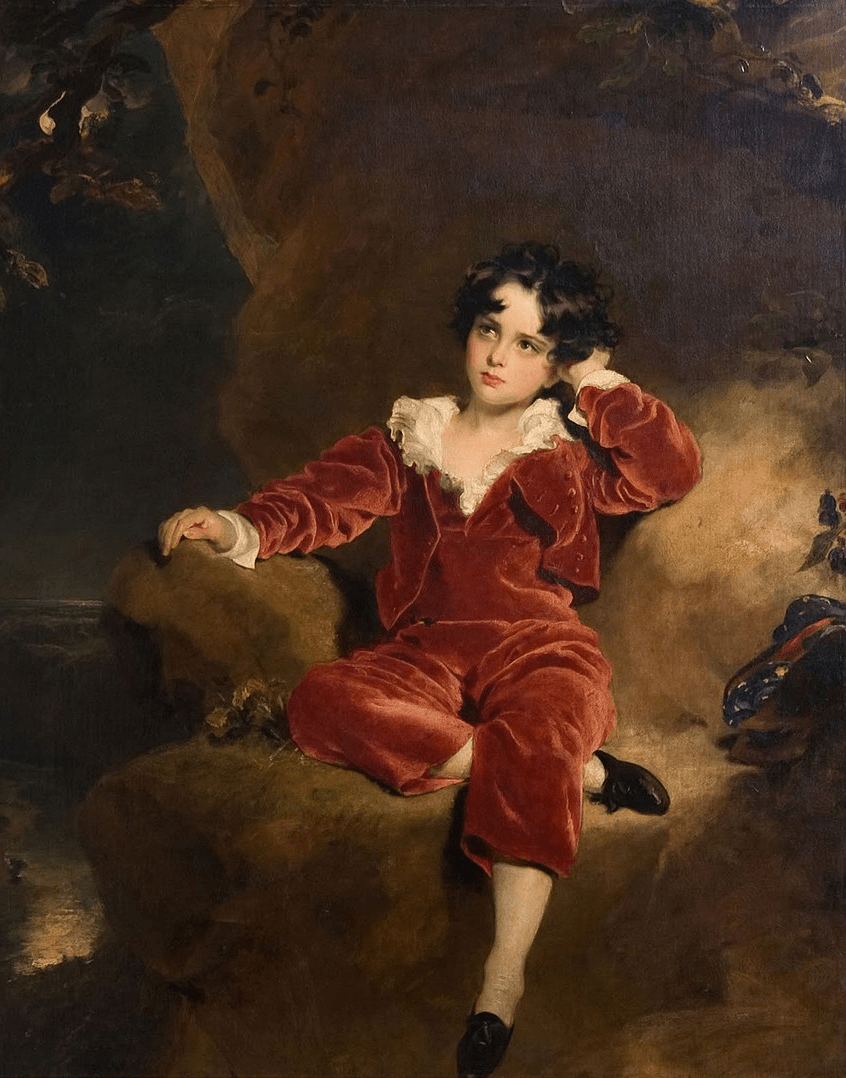
SIR THOMAS LAWRENCE, 1825
As Principal Painter-in-Ordinary to the King, and later President of the Royal Academy, Sir Thomas Lawrence was one of the most fashionable portraitists of the late 18th and early 19th century. He followed in the footsteps of Joshua Reynolds, who preceded him in both roles and had been a major artistic influence on Lawrence in his youth. Like Reynolds, Lawrence was praised for his skilful handling of paint as well as his talent for capturing the likeness of his sitters.
The Red Boy is one of his most famous works, and was the first painting ever to be reproduced on a British postage stamp. It shows a well-dressed child in a moment of contemplation, gazing off into the distance, with a glimspe into the dramatic landscape behind the rocks where he sits. The child in question is Charles Lambton, the eldest son and heir of John Lambton, who at the time was an MP for County Durham, later to become Viscount Lambton and Earl of Durham in 1833. The budding flowers besides Charles are a symbol of innocence and childhood, however his youth was not to last, tragically cut short as he died from tuberculosis aged only thirteen, just six years after the painting was completed.
Officially, the painting is titled Charles William Lambton, but it is more popularly known as The Red Boy, in line with a later tradition for naming portraits of children after the colour of their clothing, in the manner of Thomas Gainsborough’s The Blue Boy. Although, it might have been The Yellow Boy if John Lambton had not intervened, as contemporary sources claim that Charles had originally worn a yellow outfit for the portrait, but that his father had protested so fiercely against the “unfitness of the colour” that Lawrence relented and painted over it in red, and so The Red Boy was born.
 Art History Explained
Leave a comment