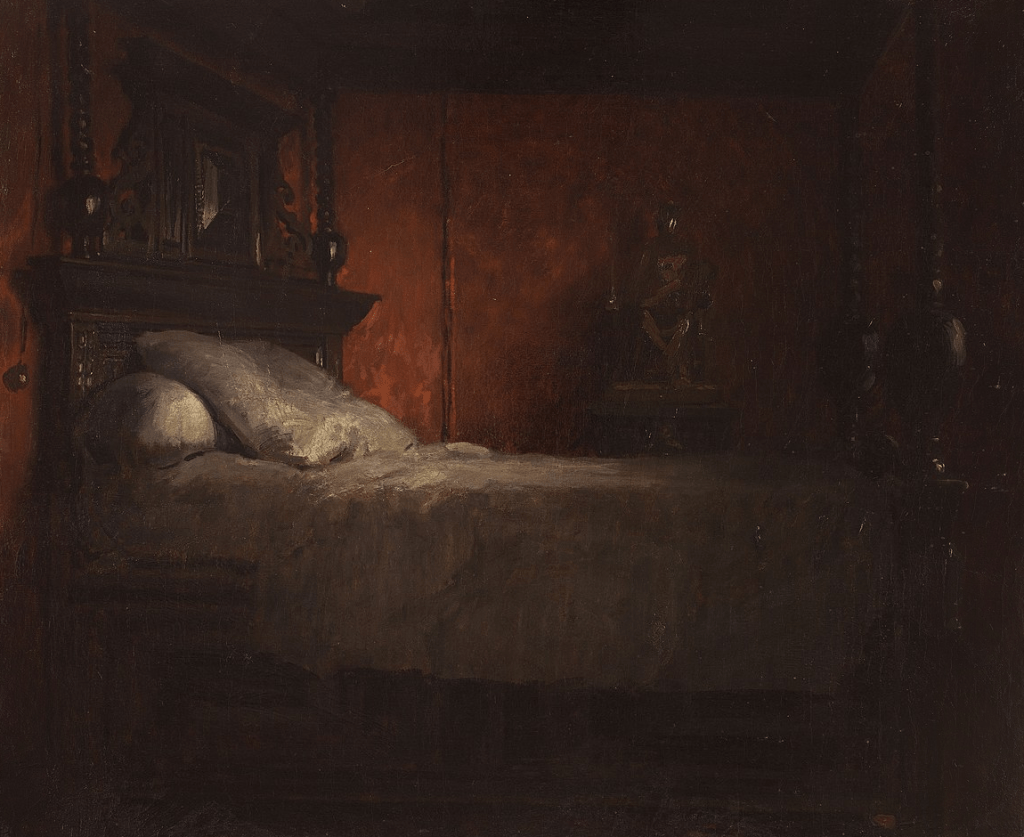
DÉSIRÉ FRANÇOIS LAUGÉE, 1885
While Désiré François Laugée enjoyed a successful career as an artist during his lifetime, rising to fame as the esteemed ‘Master of Nauroy,’ his life and work has fallen into relative obscurity today. He painted mostly historical and genre scenes, making La Chambre de Victor Hugo, a simple interior without any figures, unusual in his oeuvre. However, this unassuming study holds just as much power as any of his other grand narratives.
Its full title, La Chambre de Victor Hugo Avenue d’Eylau, Après sa Mort le 22 Mai 1885, gives the painting better context. It shows the room of the renowned author and politician Victor Hugo, best remembered today as the writer of The Hunchback of Notre-Dame and Les Misérables, following his death in 1885. It is recorded that Victor Hugo died in the bed pictured, and that his body was laid there until his state funeral several weeks later.
Laugée chose to omit the body from his painting, with only a slight depression in the pillow to suggest that the bed was previously occupied. The empty space is illuminated by a soft halo of light, which further accentuates a feeling of absence. La Chambre de Victor Hugo serves as a document of the room where one of the most influential figures in 19th century literature and politics spent the final years of his life, offering an intimate glimpse into his home.
Though above all, Désiré François Laugée captures the profound sense of loss suffered in the wake of his death, with the funeral of Victor Hugo attended by the largest crowds of any service in French history. A reconstruction of his room at 130 Avenue d’Eylau has been opened in the Maison de Victor Hugo in Paris, where it can be visited by the public today.
 Art History Explained
Leave a comment