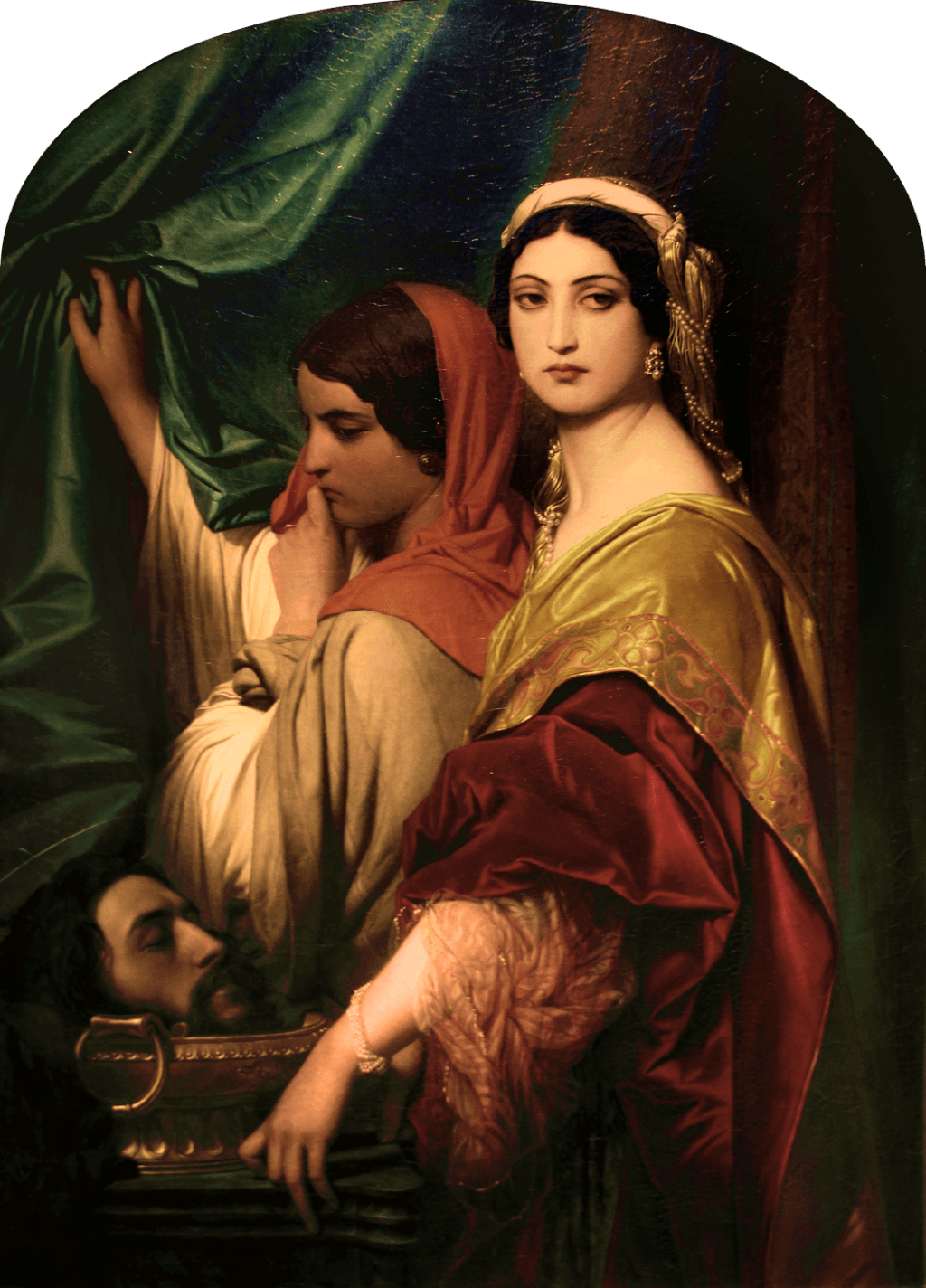
PAUL DELAROCHE, 1843
Famous for his history paintings, Hippolyte-Paul Delaroche is remembered as one of the leading French artists of the 19th century. Although Romanticism and Neoclassicism were opposing artistic movements at this time, his work shows the influence of both, as he combined a Romantic fascination for the past with a precise Neoclassical approach to rendering form and surface.
Herodias finds its source material in the Gospels of Matthew and Mark, drawing on an account of Salome dancing before Herod Antipas, the ruler of Galilee, who was so impressed that he promised her a reward of her choosing. Her mother Herodias harboured a deep hatred for John the Baptist, who had publicly opposed her marriage to Herod Antipas since it defied Jewish law, and so convinced Salome to demand his head on a platter. While Herod Antipas revered John the Baptist as a holy man, he was honour-bound to keep his promise and so ordered the execution.
Delaroche shows Herodias holding the head of John the Baptist, her revenge fulfilled. Decked in sumptuous clothing and jewellery, her dress is a mark of her royal status, but also serves to symbolise her sinful decadence in contrast to the humble, ascetic lifestyle associated with John the Baptist. Herodias looks coldly off to the side, her expression suggesting that she is not only unmoved but content at the death of the saint.
Conversely, the younger woman before her, probably Salome, appears troubled as she contemplates the head of John the Baptist, perhaps regretting her part in his execution. Delaroche offers an unconventionally sympathetic portrait of Salome here, who typically appears in art as a dark seductress that delights in the suffering she inflicts, instead placing the blame on Herodias, who is cast in the role of corrupt mastermind revelling in the success of her revenge plot.
 Art History Explained
Leave a comment