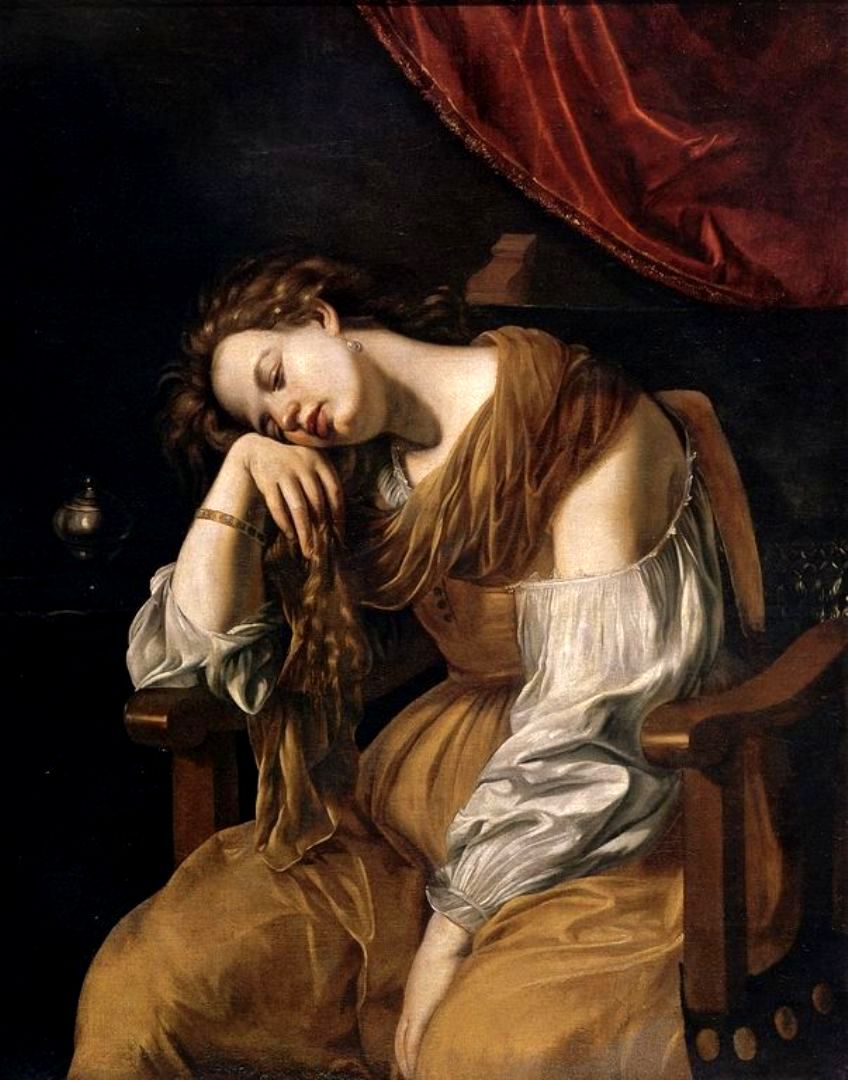
ARTEMISIA GENTILESCHI, 1622-5
For many years, Artemisia Gentileschi was labelled as something of a historical curiosity, a rare example of a successful 17th century female painter with a tragic life story that was long allowed to overshadow her artistic legacy. However, a recent influx of scholarship has seen her place in the canon re-evaluated and a clearer view of her significance brought to light, especially in the context of Baroque painting.
Gentileschi absorbed the influence of Caravaggio, casting her subjects in high-contrast lighting with a similar emphasis on physical presence and form. What sets her style apart from other followers of Caravaggio, though, is her preference for raw realism and complex depictions of women. While her Penitent Magdalene lacks the drama and dynamism of her famous Judith Slaying Holofernes, it captures a moment of equal resolve, here enacted in the realm of the spirit rather than of the body.
Mary Magdalene can be identified by her symbols, the jar of ointment and mirror, visible on the table beside her. She is situated against a backdrop of rich furnishings and wears jewellery and fine clothing, indicative of a decadent life. Still, her eyes are closed and her mind clearly turned inwards, renouncing these goods. She runs a hand through her loose hair, perhaps in reference to the Bible story which tells of her using it to wash and dry the feet of Christ, and a single tear streams down her face. Here, Gentileschi captures the turning point at which Mary Magdalene resolves to give up a life of luxury and devote herself wholly to God, arriving firm in her decision to pursue salvation even if that means leaving the safety and comfort she had grown accustomed to behind, risking persecution as a Christian in the Roman Empire for the sake of staying true to her beliefs.
 Art History Explained
Leave a comment