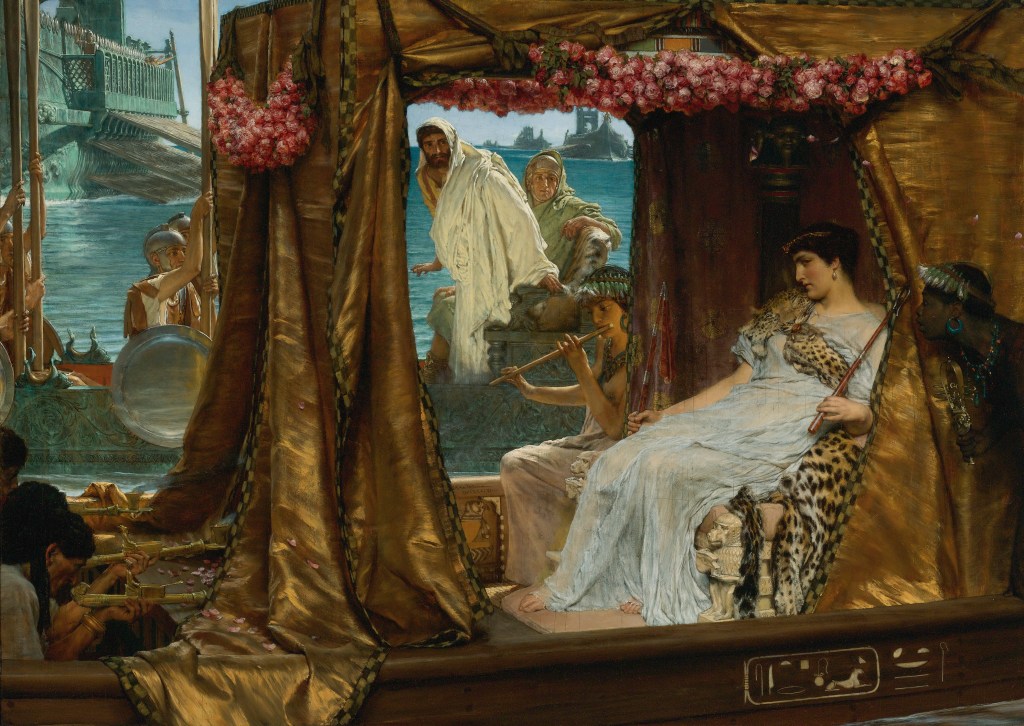
SIR LAWRENCE ALMA-TADEMA, 1883
Born in 1836, Lawrence Alma-Tadema was a Dutch painter who relocated to England in 1870 where his career flourished, being made a Royal Academician and receiving the Order of Merit. Though famous for his classical scenes, this painting does not draw its subject from ancient sources but rather a description in Shakespeare’s play of Antony and Cleopatra which was popular in London theatres at this time.
Alma-Tadema recreates the moment in the play where the Egyptian queen Cleopatra, having been summoned by Marc Antony to prove her loyalty to his rule over the Roman Empire, begins to seduce him, making a grand entrance to their meeting-place on a decorated barge. This marks the beginning of their ongoing love affair, and although Marc Antony later marries another, he eventually returns to Cleopatra, unable to leave behind their passionate romance.
Cleopatra is depicted as a vision of decadent beauty among rose garlands and rich drapery, reclining in an intricately carved throne on the barge where she is surrounded by attendants who play music and burn incense, recalling Shakespeare’s account of the “tune of flutes” and sails “so perfumed that the winds were lovesick with them.” Close behind on a skiff, Marc Antony can be seen leaping to his feet, utterly enraptured at the sight before him.
While The Meeting of Antony and Cleopatra is in part a fantasy of 19th century Orientalism, which imagined an exotic and sensual image of the East, Alma-Tadema incorporates details drawn from studies of ancient artefacts and archaeological sites to breathe life into this Shakespearean subject, treating it with his characteristic concern for historical accuracy.
 Art History Explained
Leave a comment