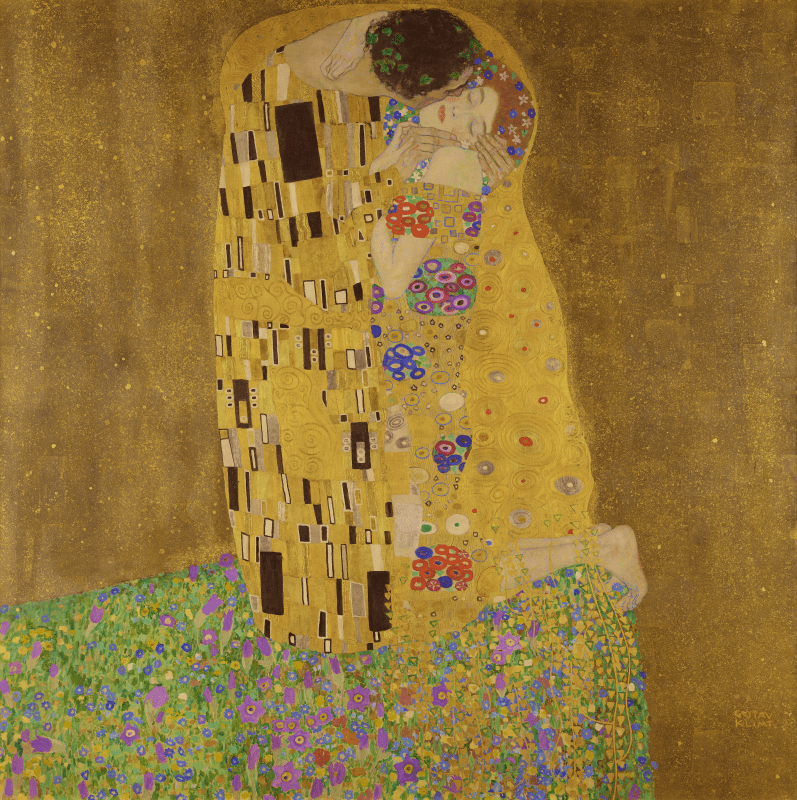
GUSTAV KLIMT, 1907-1908
Klimt’s iconic painting “The Kiss” is an image that most art lovers will already be familiar with. Endlessly reworked and reproduced, it has become a timeless symbol of romantic love. In fact, it is difficult to find a museum or gift shop these days that doesn’t sell some kind of merchandise sporting its image. Though despite its wild popularity today, the painting itself was created at a precarious moment in Klimt’s career. After the scandal caused by the unveiling of his “Faculty Paintings”, a series created to decorate the ceiling in the University of Vienna’s Great Hall which critics denounced as “pornographic” and nothing more than display of “perverted excess”, Klimt desperately needed to redeem himself in the eyes of the public.
Luckily for Klimt, his following work “The Kiss” was a huge success, being bought by the Austrian government before he had even completed it. The painting is now seen as a staple of the Art Nouveau movement, a period in Art History preceding the First World War. The movement saw a shift away from the rigid Academic style that had previously dominated the 19th century, and instead began to promote dynamic motion and asymmetry in art. Taking inspiration from the freedom and fluidity of the natural world, artists introduced the movement’s characteristic curving forms and ornate flourishes, both of which are visible in “The Kiss”. Here, the figures rise from the ground like the flowers at their feet, intertwined in a loving embrace. We can just about glimpse the face of the male figure as he cranes his neck away from us, either anticipating a kiss or planting one on his lover’s cheek.
Their costumes are heavily ornamented. Mosaic-like rectangles of black, gold and grey decorate the male figure’s robes, Klimt likely choosing these structured forms to imply a masculine semantic of resoluteness and strength. On the other hand, the robes of the female figure are covered with swirling lines, curves, and circles: forms typically associated with femininity. In this image, we see a fairly traditional gender dynamic, though its presentation is somewhat nuanced. We can infer that the male figure is more assertive, inciting the kiss upon the passive female figure and supporting her head as she leans languidly against him. Unlike the sultry femme-fatale favoured in much of Klimt’s work, the female figure in “The Kiss” is meek and demure, one again reinforcing traditional gender roles, perhaps in an effort to please his more conservative contemporaries.
Regardless, the piece is famed worldwide as an emblem of romantic love. Before creating “The Kiss”, Klimt had already experimented with the subject of a lovers embrace in his “Stoclet Frieze” and “Beethoven Frieze”, both of which explore themes of romance and intimacy. The painting is even thought to have a personal resonance for Klimt, as it is rumoured that his companion Emilie Flöge modelled for the female figure. However, there is no evidence to support this claim, and while it makes for a thrilling story, the female lover bears far more resemblance to the model for his 1907 painting “Danaë”, among others.
Perhaps the most striking element of the painting, though, is the gold background and embellishments that engulf it. Resembling the gold-ground paintings of the medieval period and the decadence of Byzantine mosaics, Klimt elevates his subject matter into the realm of the sacred, equating romantic love to a sort of religious devotion. His use of gold also adds material value to the work, while the opulence and splendour on display here evokes a feeling of awe in the viewer. Ultimately, the painting communicates the importance of love, idolising the lovers by framing them against this sea of gold. At its crux, the romance that Klimt illustrates in “The Kiss” enabled him to win back his reputation and secured the painting a permanent place as a masterpiece of the Art Nouveau period.
 Art History Explained
Leave a comment