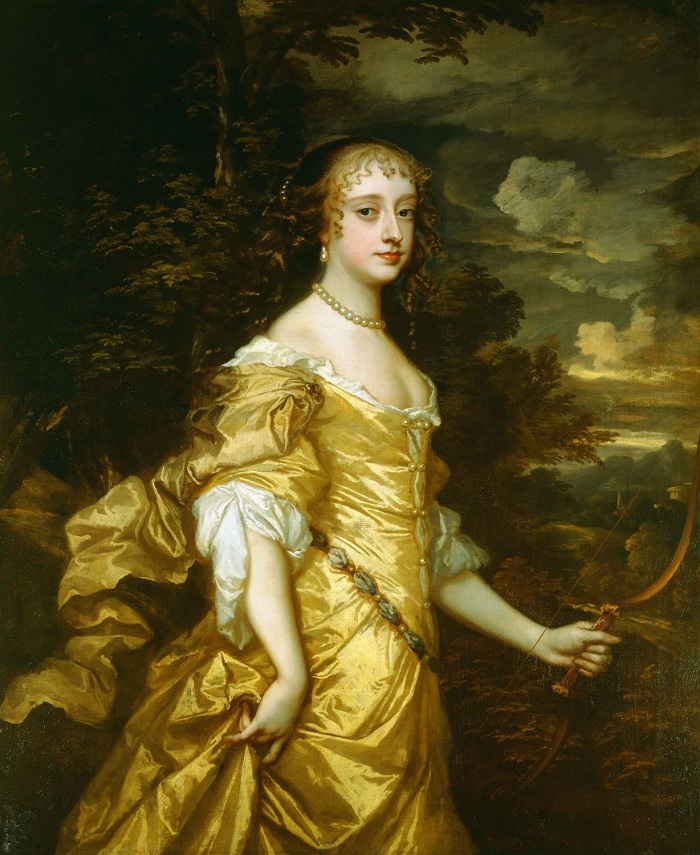
SIR PETER LELY, 1662
Forming a part of the famous ‘Windsor Beauties’ series, Sir Peter Lely’s “Frances Stuart, Duchess of Richmond” simply dazzles its viewers. Decked out in all her finery and draped with jewels, Frances Stuart glides across the picture space, glowing like a candle-flame against the darkened landscape behind her. However, she is far more than just a pretty face. Her dark eyes avoid our gaze and her expression remains inscrutable. Dishearteningly, she seems completely uninterested in us, and advances swiftly onward, seemingly preoccupied by something else altogether. To top it off, the bow in her hand seems an unlikely accessory for a well-to-do woman of the court, and there isn’t an arrow in sight.
So what could it all mean? The bow is perhaps our most essential clue. As an attribute of Artemis, the Greek virgin goddess of the hunt, it most likely alludes to Frances Stuart’s lasting reputation as ‘almost-mistress’ to King Charles II. Having continuously refused his advances, Lely compares her to the chaste Artemis, though whether the artist intended to praise or mock her with this comparison is unclear. Nonetheless, Frances’ elusive behaviour caused particular frustration for the King, who was completely infatuated by her. His devotion to this young courtier is rumoured to have resulted in her image appearing on the reverse of coins as the personification of Britannia, leading to the inclusion of this symbol on British coinage for centuries to follow. In spite of his persistence, Frances Stuart never became one of the King’s mistresses. Lely seems to hint at this dynamic, using Frances’ brisk strides and preoccupied gaze to create an atmosphere of evasion, all but ignoring the viewer and making to move on away from us. She metaphorically slips from our grasp, unlike other the beauties in the series who recline in static poses, leaning languidly against carefully placed plinths, willing the King’s attention to fall upon them.
While the portrait is held in high regard today, it was not entirely well-received. Diarist Samuel Pepys records having been to visit the ‘Windsor Beauties’ at the residence of the Duke and Duchess of York, remarking that the pictures were “good, but not like”. By commenting on the lack of likeness between sitter and portrait, Pepys highlights an aspect of Lely’s work that came under particular scrutiny during his working career. To flatter his sitters and give an unmistakable allure to even the plainest noble, he would impose upon them the features of one certain court beauty: the glamorous Barbara Villiers. As a result Frances Stuart and the other ‘Windsor Beauties’ are portrayed with sultry, heavy-lidded eyes, all remarkably like those of Villiers, their faces and bodies altered to fit the ideal standards of the time. When viewed as a series, their resemblance is quite uncanny, though as individual portraits the effect succeeds.
Like Villiers, Frances Stuart held an important position in the Court of the Restoration. Officially, she was Maid of Honour to the Royal Household, and attended to King Charles II’s wife, Catherine of Braganza. She joined the court aged only 15 and quickly rose to fame, being nicknamed ‘La Belle Stuart’ and attracting a vast array of noble suitors. Her beauty served her well in the court, and she was by all accounts a charming, yet somewhat childish, young woman. However, our understanding of her is clouded by a scathing remark made by French nobleman Philibert de Gramont, who asserts that “it is hardly possible for a woman to have less wit and more beauty” than Frances – a characterisation that has stuck with her to this day. Despite this, many modern historians regard Frances Stuart’s seeming witlessness as little more than an act in her ploy to avoid the King’s advances and maintain a respectable position at court. Instead of simply an air-headed beauty, we are beginning to see her as a measured and strategic young woman, playing to her advantage to navigate the Court of the Restoration.
While Sir Peter Lely’s ‘Windsor Beauties’ were mainly intended to show off the ravishing good looks of his sitters, his portrait of Frances Stuart reveals a whole lot more. Beneath its intricate outfitting and gorgeous Titian-inspired palette, we get the sense that Frances is slipping just out of reach. As both hunter and hunted she is simultaneously fleeing from the King’s endless pursuits and at the same time, as the object of his desire, holding absolute control over him. Lely’s portrait shows off her most desired assets to a 17th century audience – notably her beauty, chastity and nobility – but it also offers us a glimpse at a much less conventional courtier. A woman entirely unwilling to be possessed, who has intentionally, and successfully, evaded the all-powerful grasp of the very King himself.
 Art History Explained
Leave a comment