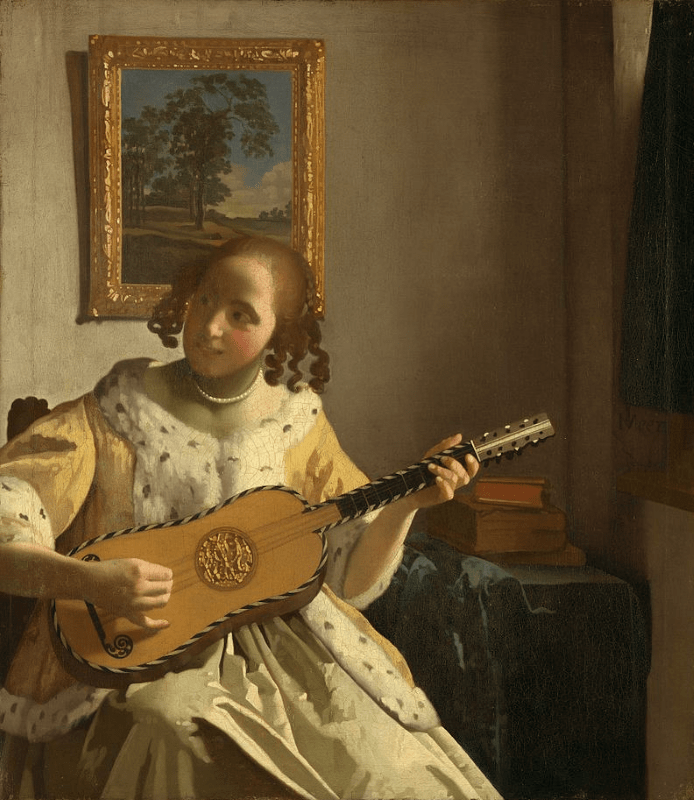
JOHANNES VERMEER, 1672
Famed for his expert handling of light and shadow, Vermeer specialised in domestic genre scenes, though was not particularly well known within his lifetime. He enjoyed moderate success but worked very slowly, using expensive pigments to build up the rich colours that soon became a signature of his art. However, following the collapse of the art market after the Franco-Dutch War (spanning from 1672 to 1678), he was unable to sustain this practice and fell under severe financial pressure, eventually dying, in debt, in 1675.
Rediscovered in the 19th century, the popularity of Vermeer’s work today has skyrocketed, making him one of the most memorable artists of the Dutch Golden Age. His painting “The Guitar Player” satisfies many of the typical conventions of his work, making it instantly recognisable and characteristically ‘Vermeer’. For example, the distinctive outfit – a yellow satin dress worn under a luxurious fur trimmed coat – appears in multiple paintings by the artist, as does the woman’s pearl necklace. Its subject of a woman playing music is another such convention, although, here Vermeer moves away from the lutes and virginals we often see in his work and instead focuses on a much more modern instrument: the guitar.
This is where the piece begins to break off from the firm tradition that Vermeer has consistently built upon throughout his career, now shifting into a somewhat experimental phase. There is an incredible attention to detail in the rendering of the guitar to the degree that some of its strings have been blurred to indicate the vibrations caused by strumming it. From this, coupled with the woman’s gestures, we can deduce that she is mid-song, turning to her right to address an accompanying player or onlooker. The guitar is much louder and full-bodied than the archaic instruments detailed in Vermeer’s previous works, giving a resulting liveliness and energy to this painting that contrasts sharply against the usual quietness found in his still interiors.
This energy is echoed in the painting’s composition. The guitar player is placed off-centre and close to the viewer, the loosely structured asymmetry inciting a sense of movement completely unprecedented in Vermeer’s art. Likewise, the light, which must enter from a window just out of the picture space, illuminates the woman from her left side, its uneven coverage adding to the asymmetry of the composition and spotlighting her against the rest of the interior. The negative space created by the whitewashed walls, another staple of Vermeer’s work, again draws our eye to the guitar player who – instead of looking back at us – gazes out toward an unseen figure.
The woman’s smiling expression coupled with the gentle tilt of her head suggest flirtation which compliments the pleasant atmosphere of the scene. Through the painting we experience many delights: the charm of the woman, the suggestion of a sweet-sounding song, the blissful domestic world, and the idyllic landscape contained in the painting-within-the-painting. All in all it is an image meant to please. We are drawn into this energetic world of beauty and song where we are invited simply to view and admire the spoils before us – perhaps meant to reflect the prosperity of the Dutch Republic itself during the Golden Age.
Ultimately, however, it is an ideal and becomes more than a little ironic given the financial strain Vermeer was under at the time he painted it. So convincingly carefree, it leaves us wondering whether the act of painting such an image was a comfort to the struggling artist or rather the source of more heartache. Encapsulating a world of easygoing affluence, the piece offers a momentary reprise from the troubles of everyday life, both for the artist and his audience back then, and to all of us now.
 Art History Explained
Leave a comment