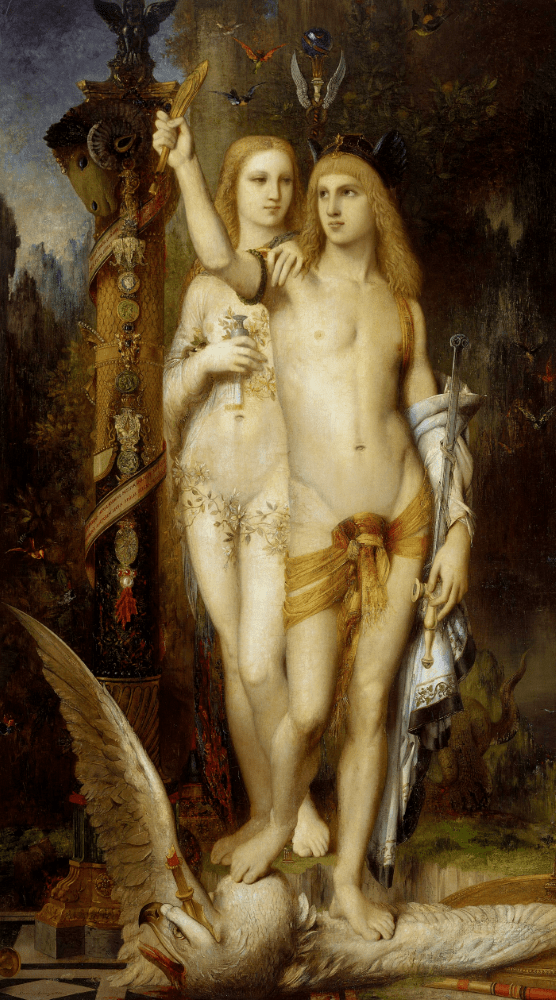
GUSTAVE MOREAU, 1865
Gustave Moreau’s “Jason” is by no means an easy painting to approach. It requires us to have a solid understanding of its source material as well as knowledge of classical Latin before we can even begin to decode the myriad of obscure symbols thrown at us. It is easy to see why such a painting frustrated and bewildered contemporary critics when it was first shown at the Salon. Nevertheless, once we start to deconstruct its complex visual language we are able to shine a light on the deeply psychological themes at play here, and appreciate the unconventional narrative it creates.
Moreau’s love of art flourished early on in life, spurred by a visit to Italy in 1841, where, aged 15, he witnessed first-hand the masterpieces of the Renaissance. This profoundly influenced his work and upon returning to Italy in 1857 after the death of his mentor he began to copy Old Master works from artists such as Leonardo da Vinci, Michelangelo, and Raphael. As a result, the presence of the Italian Renaissance can be clearly felt in some of his most famous paintings. The beautiful, muscular bodies of Moreau’s figures, each rendered with soft sfumato shading, are arranged in almost mathematical compositions – balanced and poised as per Renaissance tradition. But while Moreau emulates the Old Masters in his work, the mystic imagery and complex iconography places him firmly in the realm of Symbolism: a burgeoning movement of which he was a leading pioneer.
Here, he tells the story of Jason and Medea, legendary lovers from the realm of Greek Myth. The story takes place during Jason’s quest for the Golden Fleece when, arriving in Colchis, he is challenged by King Aeëtes to overcome a series of tasks in exchange for the fleece. However, this is no easy feat, as the tasks proposed by King Aeëtes are startlingly dangerous, and would no doubt result in certain death for the young hero. But, unbeknownst to the King, his daughter Medea has fallen in love with Jason and agrees to aid him on the condition that he will marry her should he succeed in his quest. She repeatedly uses her magical ability to guide him through the tasks, first giving him an unguent to protect him from the fiery breath of a pair of enchanted bulls which he must use to drive a plough through a field. Next, he has to sow dragon’s teeth in the ploughed field. The teeth sprout up into an army of warriors who Jason, under the direction of Medea, is able to distract and defeat. Finally, Medea administers narcotic herbs to a dragon guarding the fleece, sending it to sleep so that Jason may steal his prize. He succeeds in gaining the Golden Fleece, and the lovers run away together to marry.
Instead of illustrating any single moment from the myth, Moreau condenses the entire narrative into one image, using symbols to denote key events and ideas. Some symbols are more obvious, such as the jewelled ram’s head representing the Golden Fleece, however others are puzzlingly complex. For example, the eagle beneath Jason’s feet sports a serpents tail: a stand-in for the dragon he faces in the final task. It is unclear as to why Moreau chose to depart from the original myth in his portrayal of the dragon, but by incorporating the eagle into its design he creates an interesting parallel. The name of King Aeëtes derives from the Ancient Greek “αἰετός” or “eagle”, thus enabling us to read the vanquished eagle-serpent as a symbol of Jason’s triumph over Aeëtes’ brutal tasks. Not only does Jason physically defeat the dragon (the serpent tail), but he defeats Aeëtes (the eagle head) too by overcoming his plot.
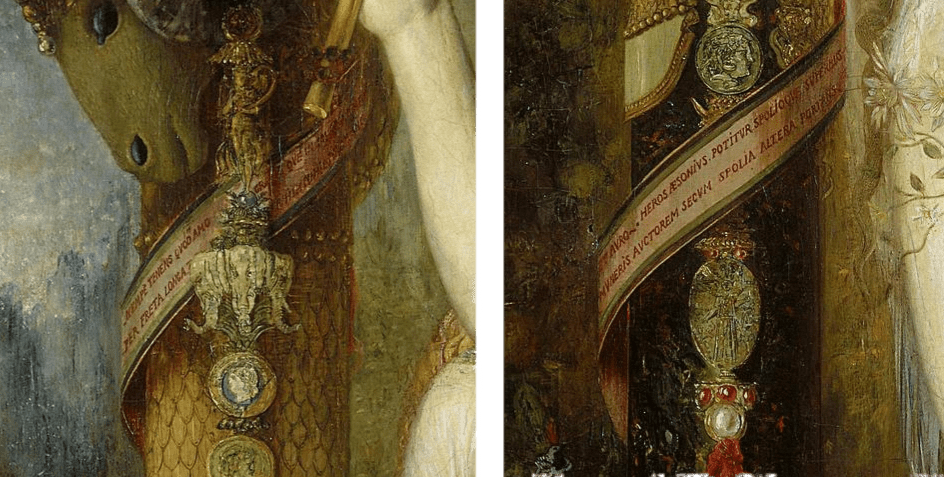
Amongst all these symbols, Moreau introduces an accompanying text to clarify some of his intentions for the piece. However, like most things in this painting, it is initially quite difficult to decipher. The text wraps around the pillar holding the ram’s head, and is an excerpt from Ovid’s Metamorphoses, an extended narrative poem written in the 8th century AD. The first half comes from Medea’s perspective, where she confesses: “nempe tenens quod amo gremioque in Iasonis haerens per freta longa ferar; nihil illum amplexa timebo” (“nay, holding that which I love, and resting in Jason’s arms, I shall travel over the long reaches of the sea; in his safe embrace I will fear nothing”), demonstrating her adoration toward the young hero. The other half focuses on Jason, recounting how “auro heros Aesonius potitur spolioque superbus muneris auctorem secum spolia altera portans” (“the heroic son of Aeson gained the golden fleece [and he was] proud of this spoil […] bearing with him the giver of his prize, another spoil”).
Although, despite this talk of “love” and “spoils”, they are hardly the image of a perfect couple. After ten years of marriage, Jason abandons Medea for Glauce, the princess of Corinth, causing the enraged Medea to slaughter her own children and poison her husband’s new lover. Thus, it is telling that Jason does not meet Medea’s gaze here. Rather he looks right past her, fixated on the symbol of the Golden Fleece. Having successfully obtained the fleece, Jason is now bound to marry Medea as was the condition of their agreement. Unfortunately, he does not seem to reciprocate her love for him, seeing her only as another “spoil” of his quest – more a commodity than a companion.
In return, a quiet malice emanates from Moreau’s Medea, and she seems entirely changed from the excited young bride-to-be described in her own inscription. This is a far later, far more vengeful Medea. A snake is draped over her arm, suggesting temptation, and linking her to the biblical figure of Eve. Much like Eve’s part in the Fall of Man, Medea will bring about Jason’s downfall, her hand on his shoulder pressing down on him ever so slightly in a subtle indication of her power. The contents of the bottle in her other hand remain ambiguous: is it the unguent used to aid Jason, or is it the poison meant to kill Glauce? Her inscrutable expression would suggest the latter.
The flowers encircling Medea’s body add to her Eve-like appearance, and are thought to be hellebores. Known for their role in witchcraft, such flowers are appropriate for the young sorceress, though their close association with danger, corruption and evil warn us to be wary of her magic. Beautiful but deadly, these flowers establish Medea as a malign presence, and their toxicity serves to remind us of her plot to poison Glauce.
Moreau’s powerful portrayal of Medea compromises Jason’s role as ‘hero’. While his pose recalls that of the triumphant St. Michael, trampling the defeated devil beneath his feet, he is physically overshadowed by Medea. She is raised in the composition, and looks down at him through a heavy-lidded gaze. Significantly, the two lovers are visually similar, both blond and fair, creating an odd doubling between them, subverting typical gender roles and implying a more complex power play. Jason is thus unable to fulfil the requirements of the ‘hero’ trope, given that he is in the presence of someone of greater power and influence. Consequently, his self-assured grandiosity here seems almost foolish, whilst his open posture and frank expression create a sense of unease as we become increasingly aware of his vulnerability to, and ignorance of, Medea’s vengeful intentions.
The painting ultimately asks us to consider this popular tale from a whole new perspective, reframing the myth to focus more heavily on the role of Medea, and subsequently the themes of power and vengeance associated with her. Perhaps it is a little ironic that a painting entitled “Jason”, places its eponymous character as subordinate, or second-best to her. Whether Moreau’s presentation of Medea is sympathetic or condemnatory, she is by no doubt a force to be reckoned with. Jason may have vanquished a dragon, but the true power here lies in Medea’s hands.
 Art History Explained
Leave a comment