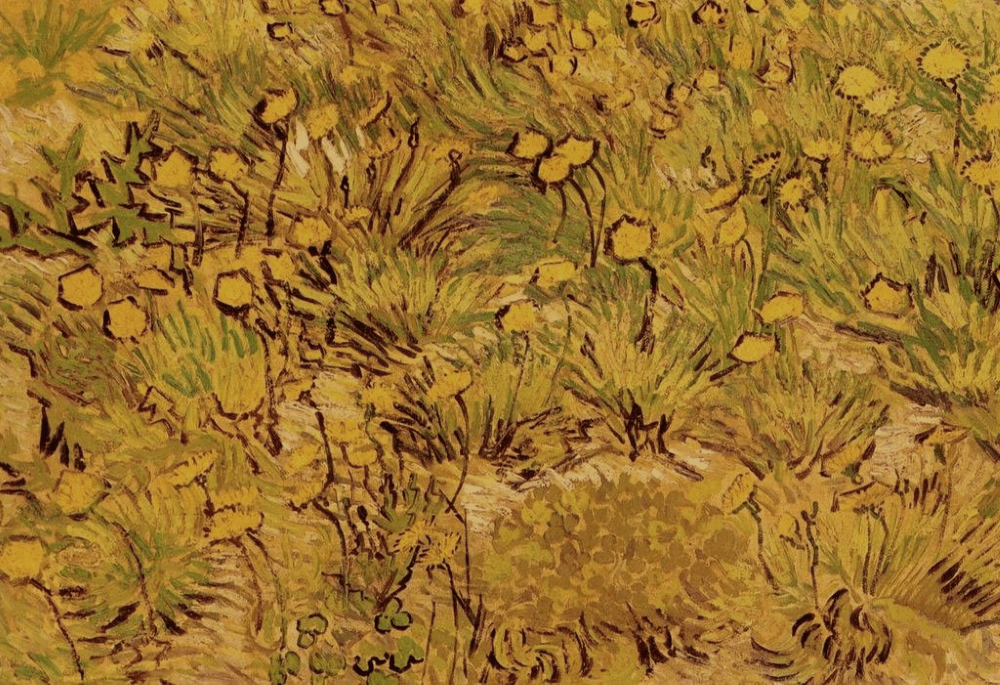
VINCENT VAN GOGH, 1889
On first glance, Vincent van Gogh’s “A Field of Yellow Flowers” may appear to be nothing more than a muddle of black and yellow brushstrokes. However, as you spend a little longer in front of the painting, it all seems to come slowly into focus. His rapid, sketchy marks coalesce into identifiable forms – a dandelion here, a clover there – and suddenly a whole world opens up before you.
While the Impressionists favoured a more naturalistic style, Van Gogh and the Post-Impressionists had begun experimenting with abstraction, distorting form and colour to create a livelier effect. This can be seen here in the flowers and leaves, many of which are made up of simple shapes. On the left hand side of the painting, the flowers are almost geometric, with bold black lines clearly delineating their forms. In contrast, on the right hand side, Van Gogh has added a slight texture and detail to the flowers: the petals indicated by means of subtle shadows and feathery brushstrokes.
In a letter to his brother Theo, written in 1888, Van Gogh admits that he wanted to pursue “a simple technique that perhaps isn’t Impressionist”, citing a desire that “everyone who has eyes could understand it”. This idea of a purely visual understanding is important to our interpretation of the painting. While it can be tempting to look for a ‘deeper’, more complex meaning to Van Gogh’s work – especially given his untimely death a mere 10 months after the painting was completed – it is more likely that “A Field of Yellow Flowers” is primarily an exercise in visual effect.
Here, we see Van Gogh pushing the boundaries of the Post-Impressionist style. His colours are oversaturated, details are simplified, and paint is layered on in thick, rapid strokes. The resulting image is almost abstract, and we are challenged to build an atmosphere from these geometric shapes and lines. Looking at the bend and sway of the grass blades, we can picture the gentle breeze that drifts across the field. Likewise, the painting’s prevailing yellow tones suggest a bright, midday sun; the flowers craning their necks toward the sky as if to soak it all in.
As Van Gogh frequently worked from life, it is likely that “A Field of Yellow Flowers” is a study taken out of doors, painted in front of the very scene itself. Yet instead of simply transcribing what he could see onto the canvas, Van Gogh has rendered the world through an abstract lens, producing a highly lyrical take on the landscape. He adopts and exaggerates the vivacious brushwork of the Impressionists, crafting an engaging new way of painting which appears here in perhaps its most extreme form. It is this distinctive style that has become a lasting trademark of Van Gogh’s art, making his work instantly recognisable, even to this day.
 Art History Explained
Leave a comment