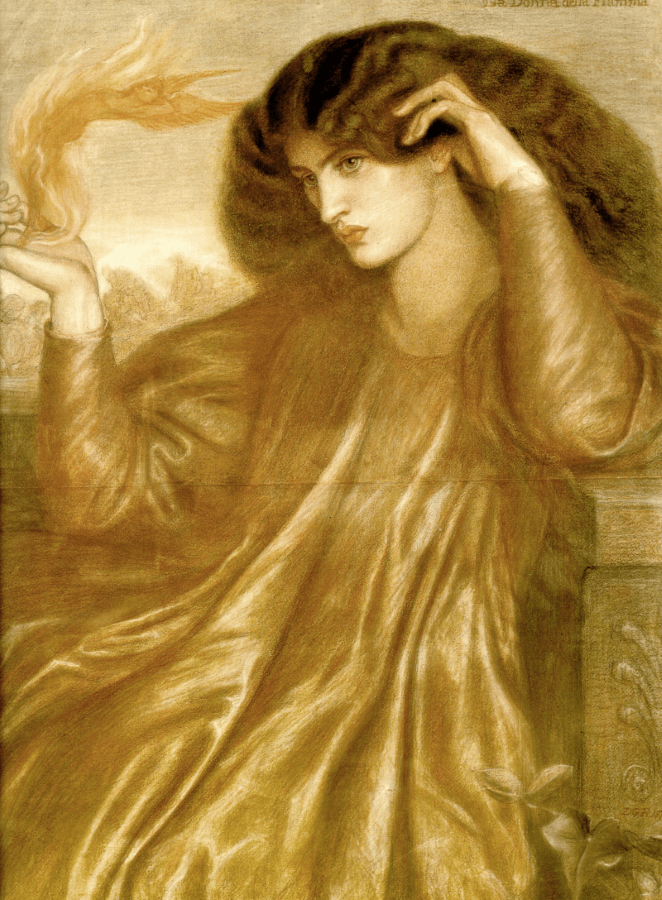
“THE WOMAN OF THE FLAME”
DANTE GABRIEL ROSSETTI, 1870
The titular figure of Rossetti’s drawing “La Donna della Fiamma” sits, like Midas, in a glittering world of gold. However, she appears remarkably uninterested by her surroundings, her jewel-like eyes gazing off into the distance. Even the fiery apparition standing on her palm fails to capture her attention.
Yet despite the sitter’s lack of interest, it is clear that the artist has taken great interest in her. She fills almost the entirety of the composition, her arms skimming the edges of the paper. Layers upon layers of chalk have been built up to create a richness of colour, with the most vibrant pinks saved for the lips and face. Elsewhere the piece is swathed in gold hues, instilling the scene with an immediate opulence.
The model for “La Donna della Fiamma” was Jane Morris (née. Burden), wife to Rossetti’s close friend and fellow artist William Morris. Rossetti was renting Kelmscott Manor with the Morrises at the time this drawing was completed, and was a good five or so years into a long and complex affair with Jane. Consequently, this image reveals a great deal about the nature of the relationship between them.
This can be observed through the apparition in Jane’s hand, which is thought to refer to a passage from Dante Alighieri’s La Vita Nuova, a text Rossetti worked to translate throughout his life. The passage describes how “spirits of love do issue in flame” from the “sweet eyes” of the heroine Beatrice. The idea of the flaming “spirits of love” imply passion, and suggest an element of danger and romance at play. Meanwhile, by alluding to the work of Dante, Rossetti (whether intentionally or not) associates the piece with the many Dantean pictures he created of Elizabeth Siddall, his then-deceased wife.
Thus, Jane is cast in the role of a lover – or more specifically as Dante’s lover. She adopts the role of the beloved Beatrice of Dante Alighieri, yet she is also portrayed solely as herself, as Jane, lover and muse to Dante Gabriel Rossetti. Through this construct, Rossetti creates a sort of double act, in which Jane/Beatrice and the two Dantes converge – using La Vita Nuova as a facade under which he may discretely express his affection for Jane, who at the time was crucially still the wife of one of his closest friends.
By considering how the drawing fits into Rossetti’s body of work, as well as the literature that may have inspired it, we are able to look beneath this facade and glean the romantic relationship between the artist and the sitter. Though perhaps it is the reverence with which Rossetti has portrayed Jane that is the most revealing of all.
Mirroring Jane’s indifference, Rossetti seems to have little care for the rest of the world around her, reducing the trees in the distance to mere smudges of chalk. Yet he has diligently drawn each individual eyelash onto her face, even taking the time to render every one of the tiny fingernails. This concentration and vigour is echoed in Jane’s stare. It leaves us to wonder what she might be looking at that could inspire such intensity, and it is tempting to imagine that the subject that her gaze seems so intently fixed on may perhaps even be Rossetti himself.
 Art History Explained
Leave a comment