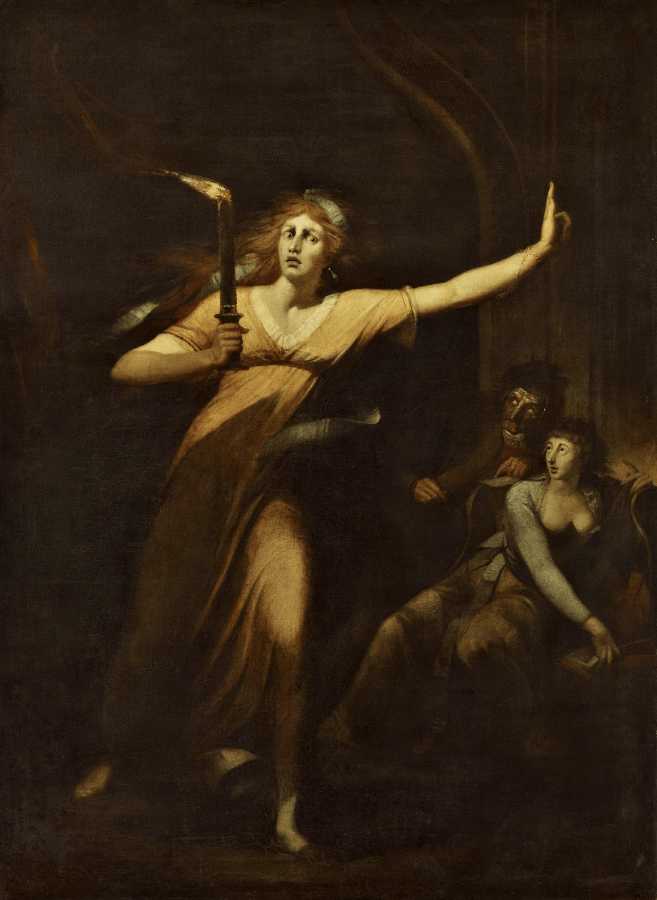
HENRY FUSELI, 1784
The near life-sized figure of Lady Macbeth darts across the composition, seizing our attention in a great sweeping motion. In one hand a candle glows ablaze, flickering with the force of her strides, while her other hand is flung out in what appears to be a declaratory gesture. Standing at 1.6 by 2.2m tall, “The Sleepwalking Lady Macbeth” lacks none of Fuseli’s love of the dramatic.
Fuseli’s subject is taken from Shakespeare’s famous tragedy Macbeth. In the scene he has chosen to illustrate, a doctor and a gentlewoman are situated in a darkened corridor discussing Lady Macbeth’s deteriorating health. All of a sudden she emerges with a candle, sleepwalking into the scene. Having secretly conspired with her husband to murder the good King Duncan, Lady Macbeth now experiences a vision in which her hands may “never be clean” of his blood. Agitated, she attempts to scrub off the imaginary blood, while the two onlookers, unsettled by her odd behaviour, realise that they have seen too much and promptly leave.
Illuminated by the light of the candle, we can make out the concerned faces of the doctor and gentlewoman from within the shadows. They appear somewhat startled, as if interrupted mid-sentence, staring awe-struck at Lady Macbeth as she sleepwalks by. Clothed in sombre black and icy blue, the darkened forms of the onlookers provide a stark contrast to the painting’s primary subject, the Lady Macbeth, who arrives in a flurry of reds and golds – perhaps indicative of her impassioned state. The red tones that dominate the painting may also be an allusion to the blood that Lady Macbeth imagines while sleepwalking, reminding us of her plight.
By harnessing conventions of gothic art and literature, Fuseli gives Shakespeare’s tragedy a distinctly gothic feel. While some tropes, namely the medieval setting and blazing taper candle, are true to Shakespeare’s original tale, Fuseli has added his own sinister twists to the scene. Portrayed as a grotesque, the gnarled face of the doctor peers out from the darkness. On the contrary, the ghostly female figures appear wide-eyed and pallid. The gothic tone is echoed in their posing, with the onlookers coiled in on themselves, twisting and straining, while the grand figure of Lady Macbeth is spotlighted in a flourish of force and movement.
While strange and fantastical scenes like “The Sleepwalking Lady Macbeth” were popular during the late 18th century, this painting in particular has become an enduring icon of the medieval gothic. The unnerving image of Lady Macbeth advancing toward us – as if ready to walk straight out of the picture frame – is one that has gripped contemporary and modern viewers alike. Fuseli’s dark, eerie style remaining synonymous with the world of the gothic, even to this day.
 Art History Explained
Leave a comment