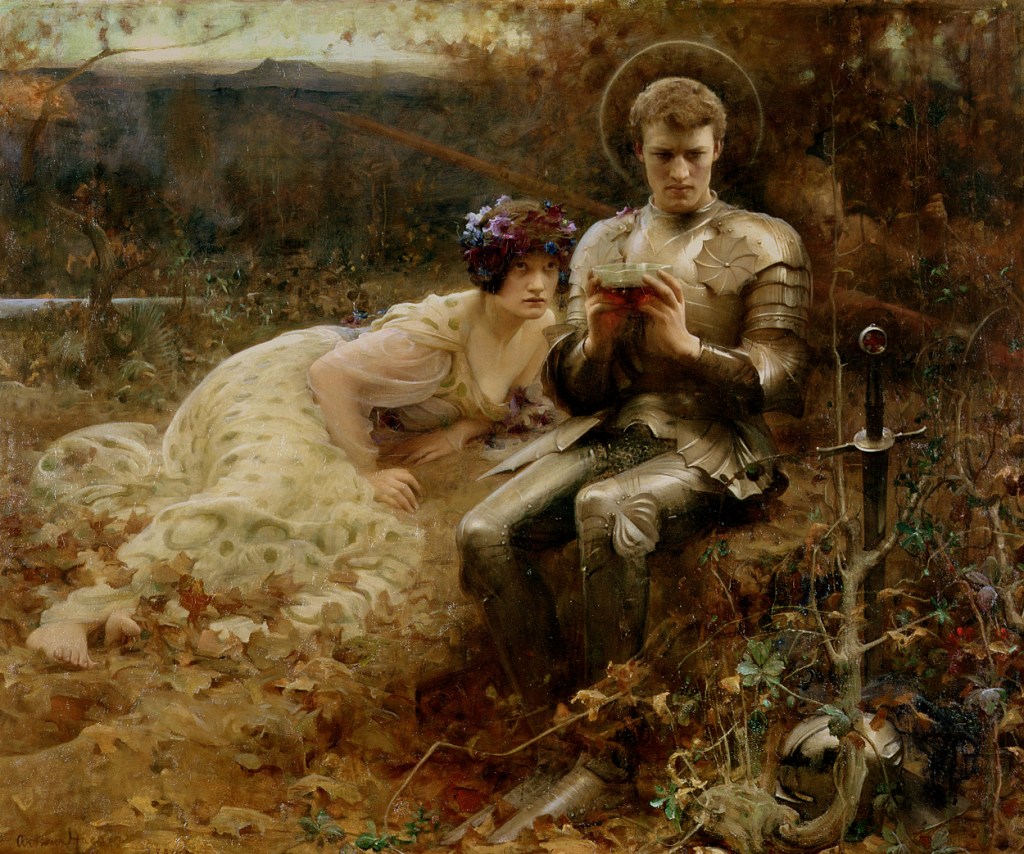
ARTHUR HACKER – 1894
Bathed in the simmering half-light of evening, Arthur Hacker’s “The Temptation of Sir Percival” ensnares us in the world of Arthurian romance, dazzling viewers with its elaborate costumes and rich colours. Yet it is no tale of courtly love that Hacker has chosen to illustrate. While he evidently made great efforts to instil the piece with a sense of beauty, there are much darker themes at play here.
The subject derives from Arthurian legend, the character of Percival first being mentioned in Chretien de Troyes’ unfinished romance Perceval, the Story of the Grail. However, the precise tale chosen by Hacker comes from Thomas Malory’s Le Morte d’Arthur, written almost 300 years later.
It recounts how Percival, one of King Arthur’s knights of the Round Table, finds himself bewitched by the devil who appears in the guise of a beautiful woman. By tempting him to sleep with her, the devil hopes to sway Percival from a path of righteousness and trick the young knight into swearing his loyalty to him instead. However, before the devil’s plot is complete, Percival glimpses the sign of the crucifix on the pommel of his sword and crosses himself, causing the devil to burst into a great cloud of black smoke. Realising he has been deceived, the knight laments, driving the sword through his thigh in penance.
In his rendition, Hacker captures a moment of grim realisation. Percival’s expression is strained as he notices the crucifix – here represented by the cross of the Knights Templar – on his sword, as if the truth has just begun to dawn on him. In his hands he holds a vessel of wine: a gift from the devil intended to inebriate him. Meanwhile, the devil-woman leans forward, gazing determinedly at Percival in an exaggerated gesture of fascination. Caught between virtue and vice, the young knight must make a choice that will determine his fate forever onwards. Likewise, we as viewers are asked to make the same decision, Hacker using clear visual cues to sway us toward the pursuit of virtue. The darkened eyes of the woman more sinister than seductive.
The halo around Percival’s head evidently suggests his piety, but there are more elusive religious symbols scattered throughout the piece. Some have likened the brambles in the undergrowth to Christ’s crown of thorns, foreshadowing Percival’s suffering following the encounter. Though perhaps more puzzling is the ghostly apparition of a child behind the two figures. This apparition has been interpreted both as the weeping Christ Child, mourning for Percival’s sins, or in contrast the devil himself, overseeing the plot. Likewise, the accompanying lance-like rod slicing through the composition remains unexplained.
Hacker’s “The Temptation of Sir Percival” is certainly bewitching, casting us into the role of the enchanted Percival as we marvel at its allure. However, the beauty of the piece is smothered by a sense of dread. Its obscure imagery, dark tonality and troubled expressions set it apart from the artist’s other works which are typically light and airy in style. Instead, Hacker reminds us of the dangers of temptation, arguing a moral message in which he asks us favour virtue over vice in our own lives – framing Percival as both a role model and a warning for contemporary viewers.
 Art History Explained
Leave a comment