NIKOLAUS SCHMIDT – c.1600
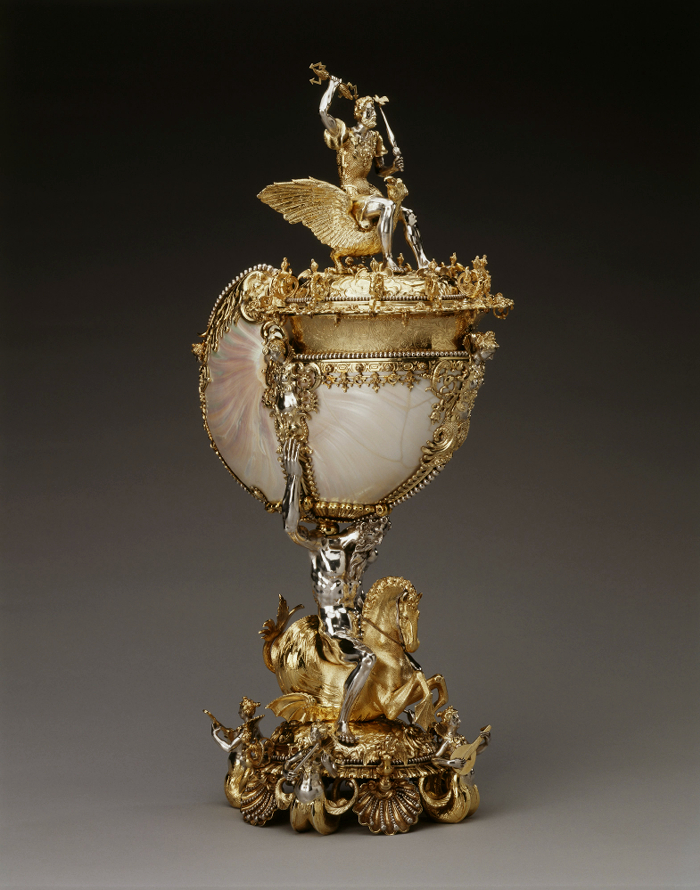
Standing at roughly 50 by 25cm high, this cup by Nikolaus Schmidt (c. 1550-1609) is nothing short of spectacular. A grand nautilus shell takes centre stage, resting atop the shoulders of a sculptural Poseidon. The shell is heavily ornamented with silver; the intricate engraving, beading and gilding lending a flourish of majesty to the piece.
Schmidt makes frequent reference to Greek and Roman mythology, a practise favoured (and often requested) by affluent patrons wishing to show off their knowledge of the Classical world. The cover of the nautilus shell features Zeus, king of the Gods, who is perched upon an eagle, lightning bolt and sceptre in hand as if ready to strike. Below the shell, Poseidon leans to bear the weight of the cup, and is sat astride a hippocamp: a mythological creature with the upper body of a horse and the lower body of a fish. Likewise, hidden along the cover and decorative base are miniature sculpted harpies – another being with its roots in Greek and Roman myth.
The legs of the base take the form of four double-tailed mermaids, their bodies visually echoed in the female busts encircling the shell. Each holds a different musical instrument, implying a collective song. This evocation of beauty – both visual and musical – is echoed in the sumptuous materials of the piece, astounding viewers with its sheer splendour. However, this is somewhat offset by the sea monster sprawled along the spine of the nautilus shell, its face leering up at the seated Zeus. An alarming reminder of the dangers of the sea.
By including Poseidon, the sea monster, the mermaids and the hippocamp Schmidt establishes clear thematic links to the ocean, reflecting the origins of the shell itself. The figure of Zeus could have been chosen to signify nobility or power, or perhaps to extend the elemental imagery of the piece to encompass air as well as water: the winged harpies, a personification of storm winds, also contributing to this idea.
The cup was acquired by George IV of England in 1823, becoming part of the royal collection. Although, it was initially misattributed to Benvenuto Cellini (1500-1571), an Italian goldsmith and sculptor, famed for his statue ‘Perseus with the Head of Medusa’ and the eponymous Cellini Salt Cellar. The nautilus cup was finally recognised as the work of Nikolaus Schmidt in 1911 when Edward Alfred Jones (an historian, antiquarian and writer) noticed a maker’s mark stamped onto it while cataloguing the collection.
Despite the change in provenance, Schmidt’s nautilus cup remains the pinnacle of extravagance. Such shells were particularly sought after by collectors from the 16th century onwards, and the intricate decorative elements of this cup only add to its appeal. Therefore it is almost no surprise that such an object would eventually fall into royal hands, becoming an unmistakable emblem of wealth and luxury.
 Art History Explained
Leave a comment