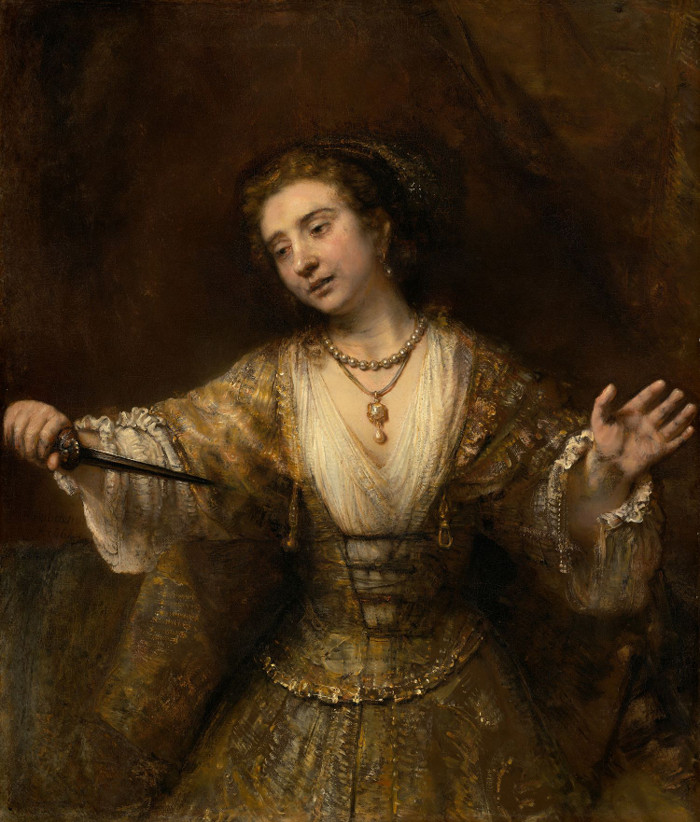
REMBRANDT VAN RIJN, 1664
Whilst the tragedy of Lucretia has been a popular subject for artists since the Renaissance, Rembrandt’s ‘Lucretia’ is one of the few works that truly manages to capture the intense emotional crisis underpinning her tale. Here, Rembrandt rejects the exaggerated violence and sexuality she is often depicted with, and instead offers us a much more introspective Lucretia.
The subject Rembrandt has chosen to explore concerns the Roman noblewoman Lucretia, who killed herself out of shame after being raped by Sextus Tarquinius. Her death was a pivotal moment in Roman history and mythology – resulting in an uprising that toppled the monarchy, transforming Rome from a kingdom into a republic.
Here, we see Lucretia in the moment before her suicide. In her right hand she holds a dagger, which she points toward herself – directing the viewer’s eye toward her chest, where the blade will soon be plunged. Subtle lighting and carefully placed white drapery draw further attention to this area, as does its central placement in the composition.
For a ‘Lucretia’, however, this painting is remarkably restrained. It lacks the sensationalised voyeurism of typical of the subject, and instead suspends us in a moment of stillness. The signature ‘calm before the storm’ seen so frequently in Rembrandt’s work.
Viewers can glean her intentions from gesture alone: violence becoming implicit rather than explicit in her portrayal. Gazing wistfully at the dagger in her hand, it is clear that this Lucretia has made up her mind and is resigned to her own fate. Yet the red brushstrokes around her eyes betray her steely determination, as do the dark circles beneath them, expressing the emotional tragedy of her circumstance.
By modernising Lucretia’s dress, Rembrandt brings her story closer to a contemporary audience. Particular attention has been lavished on the clothing, visible in the use of thick impasto to build up colour and texture on the robes. This rich attire alludes to her nobility, but also contrasts against the distress she is now suffering; the comfort and wealth she evidently experienced in life emphasising the tragedy of her suicide.
While Rembrandt’s ‘Lucretia’ is no doubt a tragic image, it omits the blatant sexuality and gore traditional to the theme. Here we experience a more contemplative Lucretia, a figure who seems distinctly human, coming to terms with the inevitability of her imminent death. Standing at approximately 1m by 1.2m tall, the small scale of the painting draws us in, bringing us closer rather than overwhelming us with a vast array of figures and props.
Fundamentally, Rembrandt seems to be more concerned with the emotional implications of Lucretia’s tragedy than the physical ones. Viewers are invited to form a connection with this heroine rather than simply perceiving her as an object of suffering. As a result, Rembrandt’s ‘Lucretia’ breathes new life and power into this Classical story, renewing its importance in the contemporary world.
 Art History Explained
Leave a comment