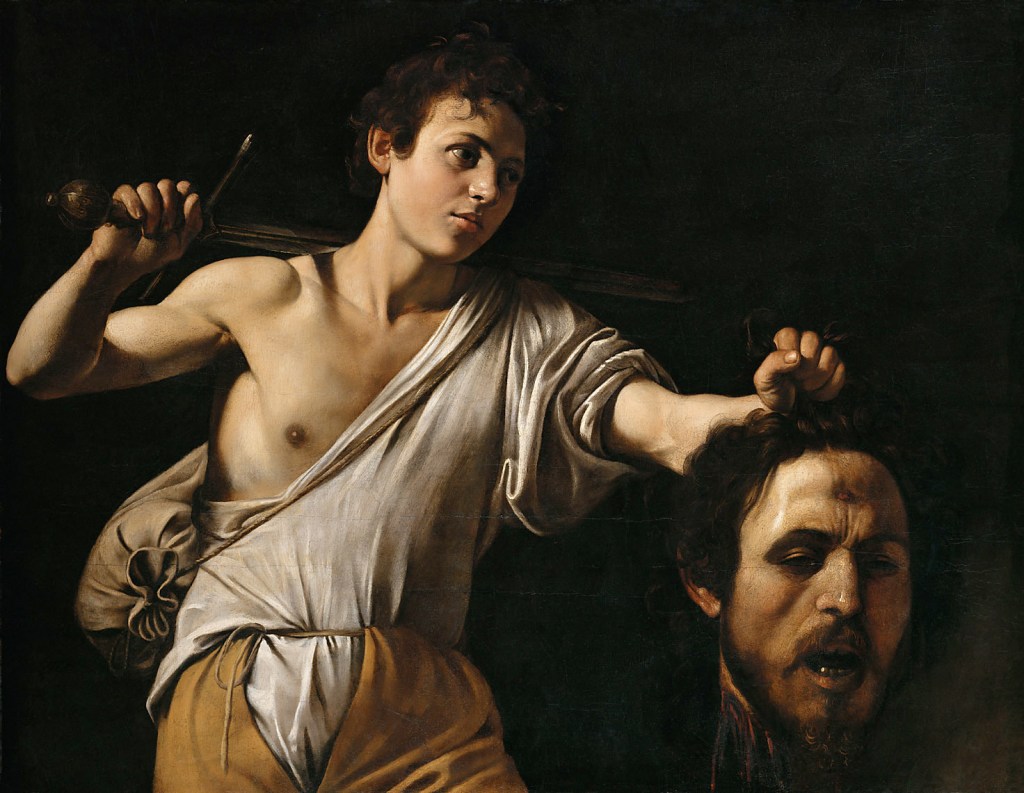
CARAVAGGIO, c.1607
Caravaggio’s “David with the Head of Goliath” presents viewers with a triumphant, yet somewhat grisly, celebration of victory. Unlike Caravaggio’s alternate rendition of the scene, this 1607 version appears primarily concerned with heroism. David proudly presents the viewer with Goliath’s head, slinging a sword over his shoulder as he gazes up away from the scene; remarkably nonchalant for having just defeated the great warrior-champion of the Philistines.
This oil on canvas piece details a biblical parable from the book of Samuel, wherein the giant Goliath is defeated by the young David in single combat. The story begins with a war between the Israelites and the Philistines, where the two armies come face-to-face in the Valley of Elah. For 40 days, each morning and evening, the champion Goliath would emerge from the Philistine army challenging the Israelites to send one of their warriors to fight him in single combat – proposing that the winner of this duel would determine the outcome of this war.
However, Saul (the Israelite King) was afraid to fight. As a result, the young David agrees to take on Goliath’s challenge, declining Saul’s offerings of armour: choosing instead to take only his staff, sling and five stones. The two champions confront one another in the valley. Goliath taunts David, cursing him in the name of his gods, to which David responds by invoking the Lord, and firing a stone from his sling. The stone hits Goliath square in the forehead, immediately striking him dead. Taking the giant’s own sword from its sheath, David cuts off Goliath’s head and the Israelites win the war.
This painting depicts the aftermath of this duel. David grips the head of Goliath by his hair, with the wound from the stone still visible on his forehead. Goliath’s brow is furrowed and his mouth hangs slightly open in a clear expression of frustration. This shadowy head with its dull eyes and unkempt beard contrasts completely against the glowing youth of David. Strongly lit from the left in Caravaggio’s characteristic chiaroscuro style, David’s figure seems positively angelic, perhaps suggesting his righteousness and devotion. Meanwhile, the light glinting off Goliath’s sword reminds us of the grim task he has fulfilled, as does the blood still dripping from the decapitated head.
At its core, the piece showcases the triumph of David in the face of a seemingly far greater foe. Compared to many of the grand dramas of the Baroque period, however, this is somewhat of a restrained depiction. With no blaring fanfares, adoring cheers, or swooning crowds, Caravaggio’s “David with the Head of Goliath” confronts us with a much quieter victory. The void-like darkness isolates these figures, as the viewer becomes the audience that they address. Once a humble shepherd, and now the soon to be King of the Israelites, this painting presents a pivotal moment in the life of David. Caught between heroism and contemplation, we are able to glimpse for a moment the complex character he embodies, as brutality and devotion collide.
 Art History Explained
Leave a comment