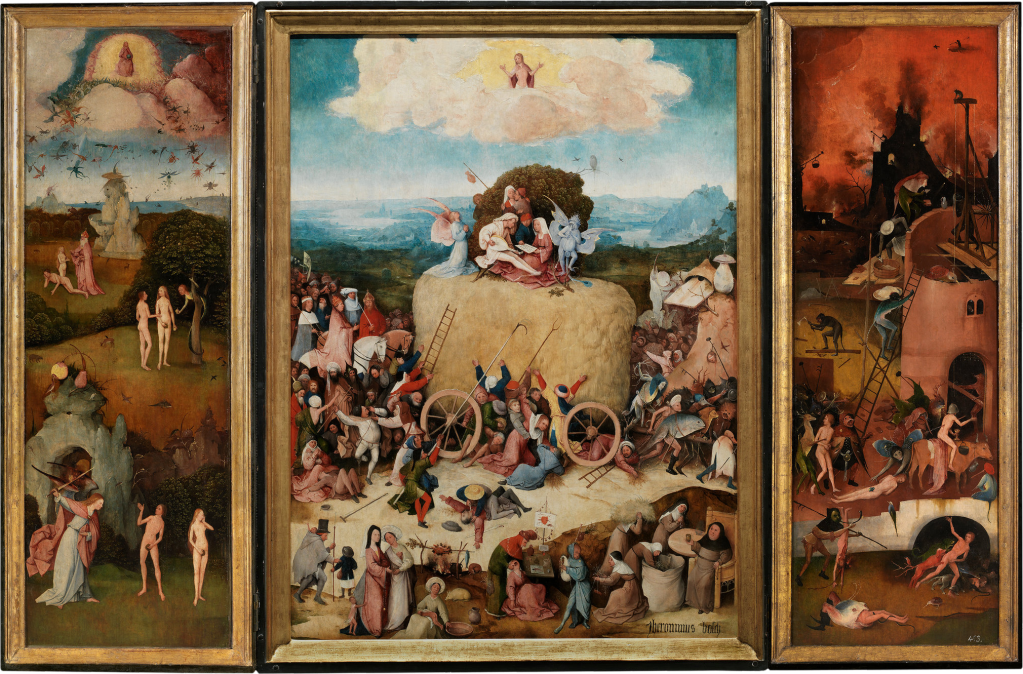
HIERONYMUS BOSCH, c. 1515
Like much of Bosch’s work, “The Haywain” is primarily concerned with sin. Dated at around 1515, the triptych is one of his later paintings and seems to profess a warning tale to its viewers, encouraging them not to fall victim to earthly goods and desires.
Visible on the leftmost panel is the biblical tale of the Fall of Man. Each stage of the narrative is depicted at once, separated by rocks, foliage, and sky, enabling us to read the scenes as they play out. In the uppermost section of the panel, God sits atop his heavenly throne, casting out the rebel angels who have now transformed into hideous bug-like creatures. Next, we see Eve being created from the rib of Adam. Below this, a humanoid serpent offers Adam and Eve an apple from the tree of knowledge, tempting them to try the forbidden fruit. Finally, we see their expulsion from the Garden of Eden, as the angel Jophiel banishes them, sword raised.
In this final moment of the tale, Bosch’s moral message becomes clear, foreshadowing the dire consequence of sin. It is a pitiful scene. Adam and Eve cower in their nakedness, and Eve turns away, consumed by guilt. Adam appears to be pleading with Jophiel, his arm raised in a gesture of desperation, though Jophiel’s steely expression implies his indifference to Adam’s requests. This powerful image of sin and suffering reveals the key themes of the triptych, while simultaneously hinting at the underlying meanings of the following panels.
At a glance, the centre panel is bursting with life and colour. This crowd of pink, yellow, blue, and cream gives off an immediate impression of merriment and joy. Though if we look a little closer, the scene turns sour. Revellers are crushed beneath the wheels of the great haywain and a man’s throat is cut in the foreground, his body laid splayed out in the dirt. Onlookers clamour to ride upon the hay, pushing and shoving one another aside, unaware of the gaggle of demons that are drawing the cart out of the frame and into Hell itself. Behind them, the rich and powerful members of society march on blindly, oblivious to the horrors that will surely follow.
Atop the haywain sits a wealthy couple who indulge in music and song, ignorant of the vision of Christ up above them. The guardian angel at their side appears to be the only one taking notice of this apparition. Unfortunately, as indicated by the angel’s grim expression, the couple will not receive salvation: instead their souls will be collected by the demon to their right, who prances on the woman’s robes in mocking celebration. However, they seems complexly oblivious of the chaos surrounding them. Likewise, their servants are distracted by lust and luxury, taking the chance to frolic in the bushes behind. Here, the image of not one, but two couples succumbing to temptation draws a distinct parallel with the story of Adam and Eve – supported by the tale’s appearance on the previous panel – hinting at the impending downfall of these revellers.
Finally, the rightmost panel demonstrates the horrors waiting for the couple. The raging fury and chaos of hell plays out in gory detail: violence, corruption and brutality running rampart in this anarchic realm. The oppressive red sky contrasts against the bright blues of the previous panels, whist the high contrast and pits of deep black continuously draw the eye back to this nightmarish scene. In the lower right hand corner, a man is mauled by a flock of animals, whist a disembowelled figure hangs in the arms of a creature opposite, trailing their guts across the floor.
Here, Hell is still in the process of construction. Demons toil away at the walls of a tower, the ladder leaning against it placed in parallel to the one beside the haywain. Furthermore, the connection between the centre and final panel is heightened by the physical movement of the revellers who appear to walk through the frame, crossing over into Hell.
In this pantomime of sin, Bosch presents us with a cynical view of 16th century society. Human ignorance is shown to facilitate crime, horror, and transgressions, leading to the downfall and damnation of the masses. According to symbolism of the time, hay represents the insignificance of human pursuits, alluding to vanity and the accumulation of wealth. Thus, Bosch’s triptych “The Haywain” becomes a sort of vanitas – reminding us of the futility of worldly things. Ultimately, leaving us awestruck at the chaos of our own making.
 Art History Explained
Leave a comment