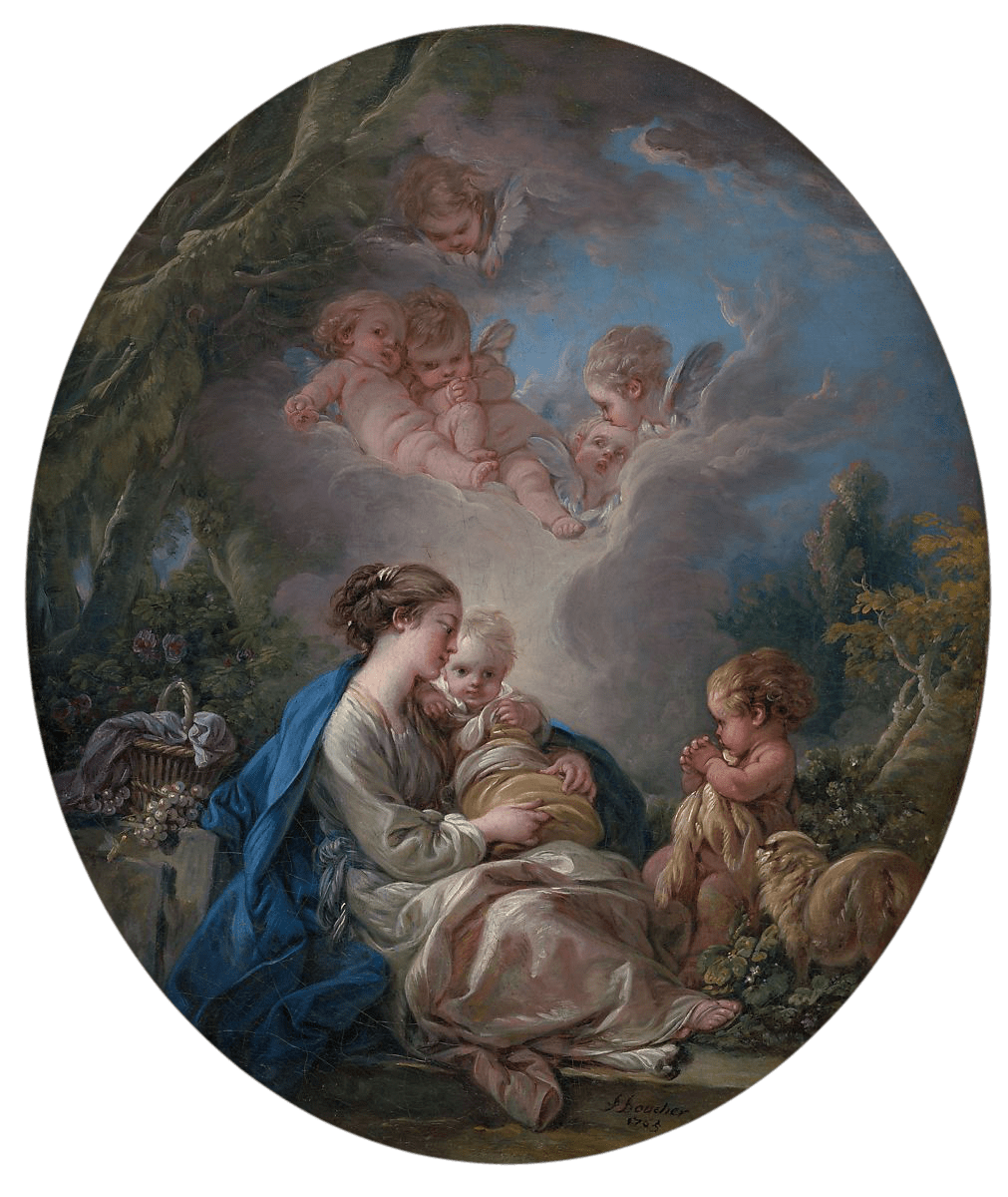
FRANÇOIS BOUCHER, 1765
Created in 1765, Boucher’s “Virgin and Child with the Young Saint John the Baptist and Angels” is a devotional piece depicting the Holy Kinship between the Virgin Mary, Jesus, and Saint John the Baptist. Measuring approximately 41cm by 35cm, this oil on canvas painting is currently owned by the the Metropolitan Museum of Art.
Boucher’s use of bright pastel tones and idealised forms is typical of the Rococo period. His characteristic voluptuous style making this piece far different from traditional renditions of religious scenes. While the majority of Boucher’s works are of idyllic pastoral subjects, this devotional piece was still vastly successful in its execution. The composition is simultaneously elegant yet natural, the figures appearing calm and at peace. The basket of grapes in the background forms a subtle nod to the Eucharist, consolidating the religious nature of this image.
Haloed by a glow of light, the Baby Jesus locks eyes with the viewer. Behind him lay a group of angels perched atop a platform of clouds. These angels appear to be conversing among themselves in admiration of the scene below, the central angel immersed in prayer, drawing the viewer’s gaze back to that of Jesus.
The Virgin Mary can quickly be recognised from her blue robe, both arms wrapped tenderly around the Baby Jesus. Saint John the Baptist, indicated by the lamb at his side, is stood across from the pair, draped in animal skin and praying fervently. Like Mary, he too gazes at Jesus, appearing enraptured by him.
As in many of Boucher’s works, nature plays a prominent role in this composition, encircling the trio in the foreground. The saturated blue tones of the sky mirror the blue of Mary’s robe, while the slanting lines of the tree trunks create a vertical upwards movement, contributing to the piece’s themes of ascension and divinity. While the presence of a rose in art has many meanings, it is probable that the roses seen in the background of this painting are a symbol of the Virgin Mary (due to her centrality in this scene), alluding to her virginity and purity.
Despite its purpose as a devotional image, it is unlikely that this work was created for a church or religious establishment. The majority of Boucher’s clientele were wealthy aristocrats and royals, and his work was a favourite of the upper-classes, notably of Madame de Pompadour, an influential member of the French court and mistress to Louis XV. Therefore, this image was presumably used for private worship, as indicated by its smaller scale and distinctive, unorthodox style.
Overall, Boucher’s “Virgin and Child with the Young Saint John the Baptist and Angels” presents an idealised take on these holy figures, focusing on the heavenly joy of this moment. Far from the stereotypical solemnity and sombreness of traditional religious art, Boucher approaches this topic from a new perspective, highlighting the delicate beauty of the scene. Perfectly encapsulating the Rococo preference for femininity and tranquillity as the dramatic flair of the Baroque period began to fade into redundancy.
 Art History Explained
Leave a comment