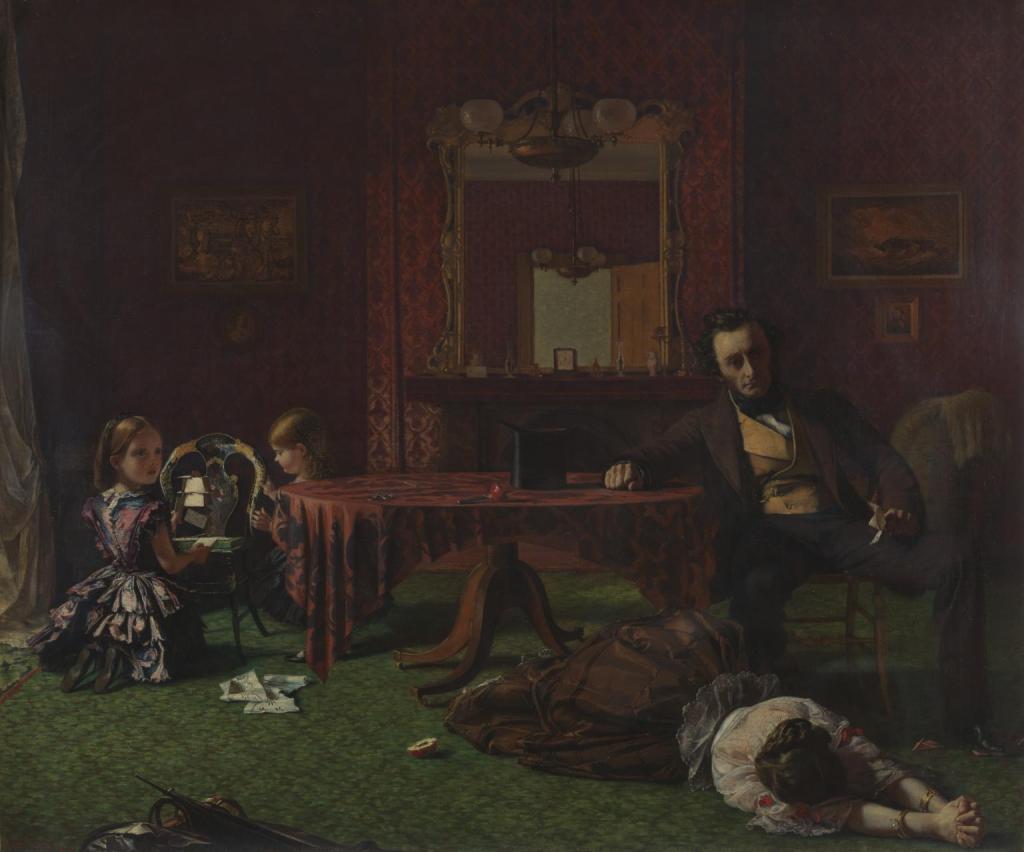
AUGUSTUS LEOPOLD EGG, 1858
August Leopold Egg’s “Past and Present, No. 1” is the first in a series of moralist paintings depicting a woman’s fall from grace. Measuring roughly 64cm by 76cm, this oil on canvas piece is now a part of the Tate’s collection.
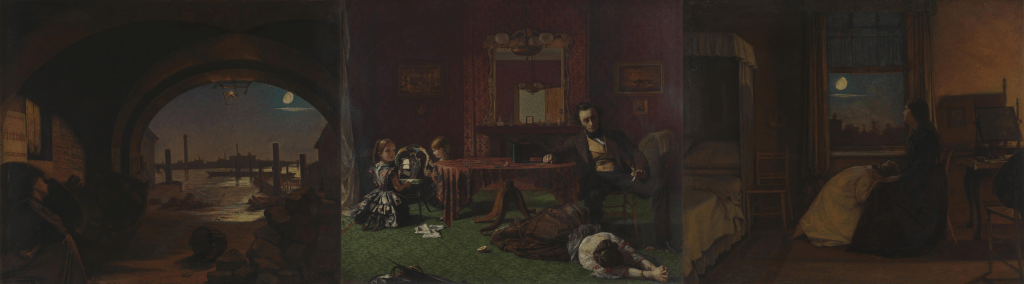
Originally exhibited by the Royal Academy in 1958, the series was left untitled, but was subtitled: “August the 4th – Have just heard that B – has been dead more than a fortnight, so his poor children have now lost both parents. I hear she was seen on Friday last near the Strand, evidently without a place to lay her head. What a fall hers has been!”
This piece details the discovery of the woman’s infidelity, and is rich with symbolism. The husband holds a letter, likely evidence of his wife’s affair, and looks down at her, dumbfounded. She lays at his feet, hands clasped together in a pleading gesture, the golden bracelets around her wrists resembling shackles – perhaps indicating her entrapment within the confines of marriage, or the restrictions of 19th century society. The repressive atmosphere created by the deep red tones of the walls and tablecloth indicates passion, violence, and fury. The two split halves of the red apple resembling the husband and wife in this image, highlighting the growing rift between them. The half laying on the floor mirroring the position of the wife. The half on the table representing the husband – the knife stabbed into the apple suggesting the emotional (and later physical) wound caused by this affair.
Themes of violence and adultery are rife in this piece, this domestic drawing room holding a multitude of double-meanings. The toy cannon in the foreground has connotations of conflict and harm, placed on a level with the miniature of the wife’s lover, crushed under her husband’s foot. In the background, the couple’s children are building a house of cards, which in this moment has collapsed, mimicking the destruction of the happy household, and the crisis of this couple’s relationship. The book that these cards were balanced upon is of note, being titled as a writing of Balzac’s, most likely a tale of adultery or affair. All these details contributing to the piece’s wider themes of a broken relationship, and the realisation of a wife’s disloyalty.
Similarly, the paintings hanging in the background hold meaning in themselves. The left piece, entitled “The Fall”, depicts the moment at which Adam and Eve were expelled from the garden of Eden, drawing a grim parallel with the scene at play here. To the right hangs a piece by Clarkson Stanfield (3 December 1793 – 18 May 1867) named “Abandoned”, detailing a shipwreck lost at sea, again adding to the desolate mood of the piece. In addition to this, portraits of the husband and wife hang beneath these paintings. The wife’s portrait is placed under “The Fall”, perhaps alluding to her, like Eve, succumbing to temptation through her affair, as well as her resulting guilt and grief. The title of the piece mirroring the original subtitle in its statement: “What a fall hers has been!”. On the other hand, the husband’s portrait is placed beneath “Abandoned”, vocalising his feelings of desertion and hopelessness. Ultimately these paintings providing an insight into the inner emotions of the figures presented here.
Furthermore, the open door reflected in the mirror may foreshadow the wife’s departure from the home, as shown in the later pieces in the series. The luxury and comfort evident in this piece contrasting with the depravity of the other images.
Through his depiction of the discovery of a wife’s infidelity here, and her eventual downfall in the pieces that follow, Augustus Egg draws in to question the strict social constructs of 19th century society. Presenting the grim consequence of this woman’s affair, and the detrimental effect this act had not only on her life, but also that of her family. Exploring the counteractive nature of society’s harsh treatment and repression of women. The series ultimately causing the reader to ponder what may have transpired had it been the husband at fault, rather than his wife.
 Art History Explained
Leave a comment