FERNAND KHNOPFF, 1896
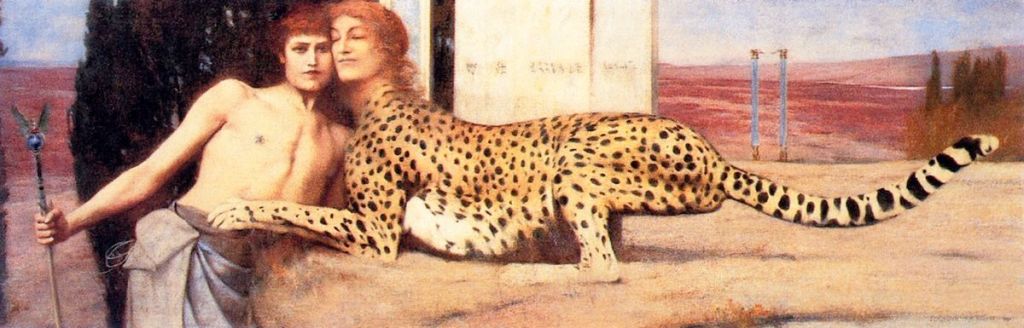
“Caresses” is an oil on canvas piece by Fernand Khnopff, created in 1896. Measuring approximately 1.5m by 5m, the painting depicts a panoramic view of an imaginary landscape, its sloping red hills stretching far into the distance. In the foreground a half-woman, half-cheetah leans against an effeminate male figure, affectionately rubbing her cheek against his.
It immediately becomes evident that the piece is steeped in symbolism (Khnopff himself a Belgian symbolist painter), though visual cues in the composition of the piece provide an insight into the key ideas at play here.
While the two figures are placed at seemingly equal heights in the composition, the female figure’s body occupies the majority of the scene, her tail nearing the right-hand edge of the piece. Her physical predominance in the painting asserts her power. This is furthered by her squared jaw and masculine features – a potential allusion to her strength through the subversion of traditional gender roles, this innate manliness hinting at her power.
However, the femininity of the male figure does not appear to diminish his power in the scene. He looks directly out of the image, establishing his confidence and dominance through his assertive stare. The rest of his body language follows suit: his shoulders are thrown backwards, and his right hand is drawn into a tight fist as he plants his staff firmly into the ground. His stance clearly demonstrating his authority and fearlessness, even spite of the cheetah-woman’s claws resting on his stomach.
While physically he appears vulnerable in comparison, his unwavering confidence alludes to hidden strength. The figure has an air of supernatural mystery – the winged staff in his hand similar to Apollo’s “Caduceus”, perhaps indicating occult power. This has led to speculation that the male figure has charmed the cheetah-woman, though others argue that the reference to classical mythology might suggest that this is a depiction of Oedipus and the Sphinx.
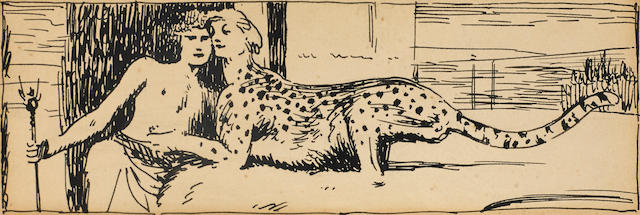
Regardless of its mythological links, the piece is thought to present something more of a personal philosophy for Khnopff. His presentation of androgyny and sexuality is typical of 19th century symbolist works; the Caduceus itself often a symbol associated with androgyny. Though much like many of his other works, the figures here exude an inherent sensuality. This is characteristic of Khnopff, who frequently explores ideas of women’s identity in his work: divided between depictions of the idealised, ‘angelic woman’, and the femme-fatale. Here both figures embodying the latter.
Through “Caresses” Khnopff distorts themes of power, gender, and eroticism in order to explore the indecipherable relationship between the two figures. Blurring the boundaries between them to create an enigmatic, provocative scene. The conventions of power are twisted, with no clear indicator as to who truly holds command. Ultimately drawing in to question the validity of the strict gender roles of the 19th century, leaving the viewer to decipher for themselves whom they think has the upper hand here.
 Art History Explained
Leave a comment