FRANTIŠEK KUPKA, 1907
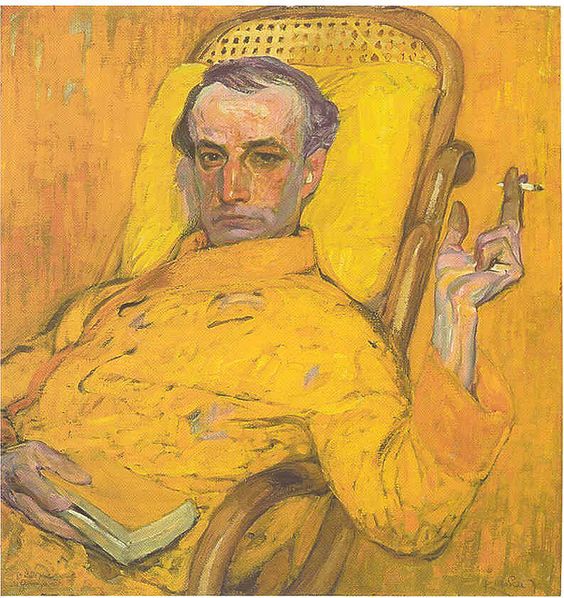
“The Yellow Scale” is an oil painting on canvas, produced by František Kupka in 1907, measuring approximately 0.8m by 0.75m. Currently owned by The Museum of Fine Arts Houston, the striking self-portrait encapsulates a spectrum of yellow tones, from rich, warm cadmiums to bright lemon yellows, contrasting with Kupka’s intense, dark stare.
Seated at the centre of the composition, Kupka is bathed in yellow light, holding a cigarette in one hand and a book in the other, meeting the viewer’s gaze with his own. Though his figure is unmistakably the focal point of the piece, the vivid yellow tones encompass the majority of the piece, from the book to the chair to the wallpaper: this world of yellow Kupka has immersed himself in demands our attention through its rich, eclectic expression of light and colour.
It’s from this prevalence of the colour yellow that the argument arises as to whether the subject of the piece is Kupka, or rather yellow itself.
Visually, the bright yellow tones dominate the composition, struck through by the pinks and purples of Kupka’s form, creating a dynamic, vibrant exploration of colour. Though the composition is fairly simple, the lively interplay between the shades of yellow introduces a layer of complexity to the piece – pushing the boundaries of the colour and challenging its visual impact through the interaction between the various tones present in the painting.
Many spiritualists and colour psychologists suggest that yellow has strong links with the intellect, curiosity, and introspection, perhaps being utilised here to communicate Kupka’s own intellectual approach to painting – demonstrated through his rigorous study into the concept of colour theory, as exemplified in this work.
Kupka went on to develop his understanding of colour, creating his own colour wheels, and choosing to paint in a bold, bright, expressive style: pushing the limits of the realist art world to fuel an emergence of abstract works.
Despite this, “The Yellow Scale” is still rooted securely in the realm of realism, lifted by its edge of the abstract in Kupka’s simplification of form and structure alongside the dramatic use of colour. The work favours atmosphere and tone over the rigidity of realist ideals, yet still retains much of the core features of realism through the coherency and technical prowess the piece showcases.
Kupka was a pioneer in the development of abstract art, constantly challenging conventions of form, colour, and structure key to the art world of the early 1900s – this self portrait embodying his active search to radicalise artists’ use of colour, providing a somewhat scientific insight into the capability of colour and our own interpretation of these shifting tones.
Regardless of whether the subject of this work was really intended to be Kupka or the colour yellow itself, the piece presents a vibrant, novel approach to portraiture – harnessing concepts of identity and spirituality through its intense focus on ‘yellowness’, challenging the typical realist works of the time in its subtle introduction of abstract features. The deceptive simplicity of the piece, when under close scrutiny, reveals to us a multitude of shifting colours and tones. Fundamentally, “The Yellow Scale” provides a pivotal point in our handling of colour in contemporary works, pushing the boundaries of colour as we know it.
 Art History Explained
Leave a comment